84% of Restoration Companies Are Open to AI. Most Are Still Writing Emails.
84% of restoration companies say they're open to AI. Email writing is still the dominant use case for the third year running. Here is what separates the companies that walked through the door from the ones still standing in the entryway.
Most restoration companies have adopted AI as a writing tool, using it to draft emails, rephrase carrier communications, and clean up job descriptions.
According to the 2026 C&R/KnowHow State of the Industry report, that has been true for three consecutive years, and the gap between companies using AI this way and companies embedding it into estimating, documentation, and operational workflows is widening fast.
What You Need to Know
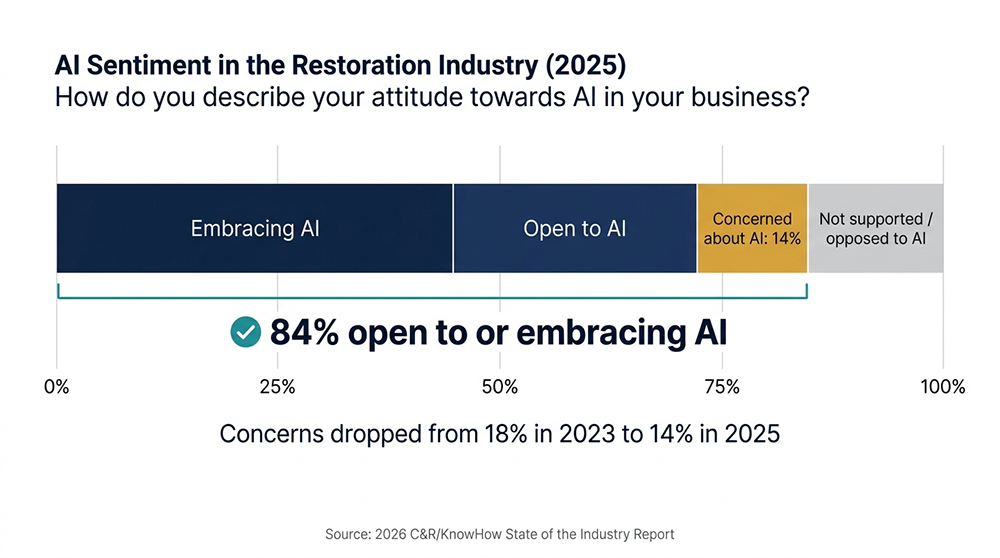
The 2026 State of the Industry report puts a number on something restoration operators already feel: 84% of the industry is open to or embracing AI, but email writing is still the dominant use case for the third year running.
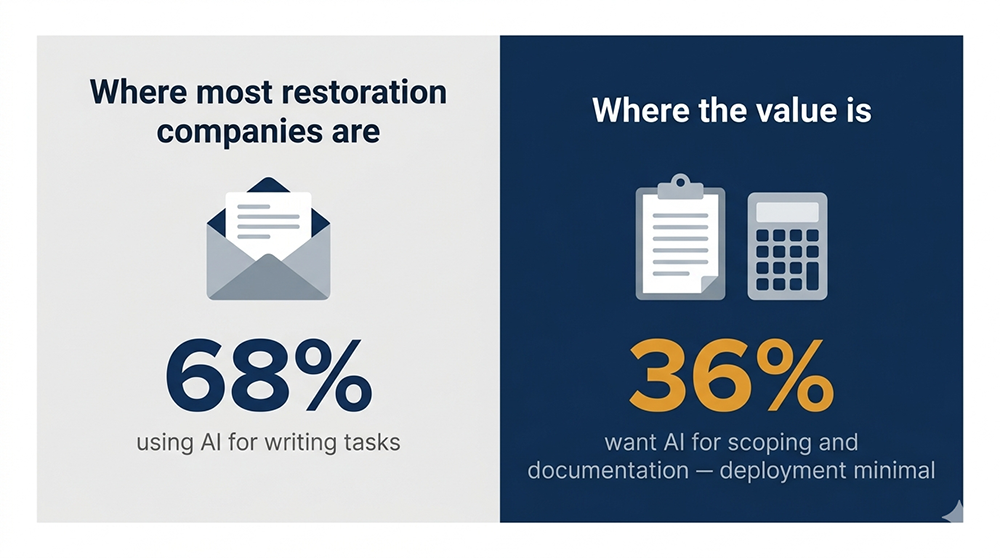
Meanwhile, 36% of restorers named estimating and job site documentation as the department they most want AI to improve, and the report's own conclusion is that deployment there has barely moved.
The companies building AI into their actual workflows are compounding an operational advantage right now. The ones standing in the entryway will feel the gap before they can measure it. One of the clearest places that gap shows up is in how fast companies get paid.
There is a specific way this plays out in the field. A restoration owner hears about AI at a conference, signs up for ChatGPT, uses it to clean up a few emails to adjusters, and concludes that AI is useful but not transformational. That conclusion is accurate for the use case they tried. It is not accurate for the use cases they did not.
The industry's relationship with AI has matured in terms of sentiment. What has not matured, for most companies, is the question underneath the tool adoption: which workflows actually benefit from AI support, and what does that look like inside a restoration operation specifically? That question is where the gap lives.
Understanding how AI workflow automation actually works inside restoration operations starts with getting honest about what most companies are actually doing with these tools versus what the highest-value applications look like. The 2026 data makes that contrast visible in a way it has not been before.
In 2022, a meaningful portion of the industry was skeptical or actively opposed. By 2023, the majority had moved to openness. By 2025, 84% describe themselves as open to or fully embracing AI, with the 'fully embracing' cohort growing year over year. Concerns about AI dropped from 18% of respondents in 2023 to 14% in 2025. The resistance is shrinking.
That trajectory looks like progress. In many ways it is. But the report draws a distinction that most coverage of these numbers skips over, and it is the distinction that matters for restoration operators trying to figure out where they stand.
The Adoption Numbers Look Good Until You Ask What They're Adopting For
Nearly 68% of restoration leaders report using ChatGPT or an equivalent tool for writing tasks: drafting emails, rephrasing communications to carriers and adjusters, writing job descriptions. Another 47% say they are using AI-enabled apps embedded in their existing software stack.
Those numbers add up to broad adoption. What they do not add up to is operational transformation.
The report names this plainly: email writing has been the dominant use case for the third consecutive year, at every company size and in every region. The tools have proliferated. The use cases have not.
A company using ChatGPT to draft a follow-up to an adjuster is doing something genuinely useful, and doing the same thing every one of their competitors is doing. The efficiency gain is real. The competitive advantage is not.
Broad AI adoption and meaningful AI deployment are two different things. The industry has achieved the first. Most companies are still working on the second.
When the report asks which department restoration leaders most want to improve with AI, 36% name estimating and job site documentation. Training and knowledge management comes in at 22%. Sales and marketing at 16%. Project management at 10%.
The appetite for AI in the workflows that drive revenue and margins is clearly there. The report's follow-up is equally clear: estimating and documentation are still being handled mostly the same way they were before AI became a household term.
The Gap Is Real, and It's Already Competitive
The report uses language worth sitting with: the gap between companies using AI as a writing tool and companies building real operational infrastructure is widening, and it is becoming a competitive one. It goes further. Companies on the wrong side of that gap will feel it before they can see it.
That framing is not hype. It reflects something specific about how operational advantages compound in restoration.
A company that has reduced the time its estimators spend building scopes from scratch, or that has cut the documentation cycle between field assessment and carrier submission, is not just recovering hours. It is closing jobs faster, getting paid sooner, and freeing up capacity that goes back into the next job. Those gains are small at first and nearly invisible from the outside. They become structural over time.
According to Verisk, overall claim volume was down approximately 20% in 2025. In that environment, the companies that tightened operations, improved documentation habits, and invested in workflow efficiency came out of a difficult year in a stronger position than the ones that did not. The report's introduction says exactly that. AI was one of the tools those companies used. Email drafting was not the primary way they used it.
Why the Entryway Is So Crowded
The gap in the data is not a technology problem. Restoration companies are not failing to deploy AI beyond email because they lack access to tools. ChatGPT, Claude, Gemini, and a growing list of AI-enabled platforms are available to any company with a browser and a credit card. The tools are not the constraint.
What is missing, for most restoration companies, is a clear operational question to answer before the tool gets selected. The companies that have moved beyond email did not do it because they found a better tool. They did it because they identified a specific workflow that was costing them time or margin and built an AI layer around that problem. That sequence, problem first and tool second, is what separates meaningful deployment from the entryway.
The workflow clarity work that precedes any AI decision is the step most companies skip. They adopt the tool because it is available and the first use case is obvious. When the obvious use case turns out to be limited, they conclude the tool is limited rather than recognizing they never asked it the right question.
The First Use Case Is Also the Lowest-Value One
Email drafting is a reasonable first experiment with AI. It requires no workflow mapping, no configuration, no integration with existing systems. You open a chat window, describe what you need, and get something usable in thirty seconds. That ease of entry is genuinely valuable as an on-ramp. It is also exactly why it does not produce competitive advantage.
The efficiency gain from AI-assisted email drafting is real. But when 68% of the industry is using the same tools the same way, the gain is shared across competitors. No one company is faster at closing jobs or collecting payment because their carrier emails are slightly better written. The improvement is marginal and symmetric.
The first AI use case most restoration companies try is the one that requires the least workflow thinking. That is also why it produces the least operational value.
There is a version of this observation that sounds like criticism of the companies still at the email stage. It is not. The email stage is a legitimate starting point, and the report acknowledges that any efficiency gain matters when margins are under pressure. The problem is not starting there. The problem is treating it as a destination.
The Deployment Gap Is Not a Tech Problem
The companies that have not moved beyond email typically share a specific profile. They know AI could do more. They have probably seen a demo or read an article that showed a compelling use case. What they do not have is a clear answer to the question: which specific workflow in our operation should we tackle first, and what does AI look like inside it?
That question requires operational self-knowledge that most restoration companies have not been asked to develop. Three diagnostic questions tend to surface the answer:
Where does the most time go between job intake and estimate submission?
Where do scope errors originate, and at what point in the process do they surface?
Which documentation steps are consuming estimator hours that do not require estimator judgment?
Without answers to those questions, AI tool selection is guesswork. And guesswork at the tool selection stage produces the same outcome every time: a tool that gets used for the one obvious task and ignored for everything else.
This is the structural reason the entryway is crowded. It is not skepticism. It is the absence of a diagnostic frame that tells operators where to point the tool. The human-in-the-loop AI model that produces the most value in restoration operations is built on exactly that frame: identify where human judgment creates the most value and build the AI layer around that answer. What comes before the AI decision is the operational question. Most companies skip to the tool.
There is a specific misconception underneath this pattern that is worth naming directly. Many restoration companies have equated AI access with AI deployment, and those are different problems entirely. The platform is running. The license is paid. The tools are available. And the workflows have not changed.
Access to an AI tool is not the same as knowing which operational problem to point it at, or how to structure the work around the answer it produces. The report's data confirms this at industry scale: broad access, minimal operational change. That is the gap the 84% figure is measuring.
The Department Where the Gap Costs the Most
When the 2026 report asked restoration leaders which department they most want to enhance with AI, estimating and job site documentation came back at 36%. No other category was close. The appetite is there, and it has been there. What the report makes clear is that the deployment has not followed.
That gap is not equally expensive across all departments. Estimating and documentation is where scopes get written, where insurance-ready reports get built, and where the quality of that work determines how fast and how fully a company gets paid. It is the highest-leverage target in the operation for AI deployment, and it is the one where the distance between desire and action is largest.
The Number That Should Get Every Estimator's Attention
Getting paid is now the industry's number one problem. The 2026 report puts it at 40.8% of respondents naming it as their top challenge, up from 32.2% the year before. The report identifies four contributing factors, and what they all have in common is documentation:
The TPA problem. Managed repair programs typically pay on their own timelines, which are often slow and not negotiable. Companies that increased their TPA reliance in slow-claim years may have traded one cash flow issue for another.
The supplement problem. When scope changes require additional payment, getting carriers to approve and pay supplements is time-consuming with no guaranteed outcome. Companies that are good at documentation get paid faster. Companies that are not lose margin they earned.
The carrier problem. Some insurance carriers are simply slower than others, and some are harder to work with. Knowing which carriers you want to work with is a legitimate business strategy, and it starts with documentation that reduces dispute opportunities.
The internal process problem. Many restoration companies do not have clean, consistent AR processes. They chase payments reactively instead of building collection into the workflow from the start of a job, and the documentation trail that would support faster collection is often incomplete.
The department restoration operators most want AI to improve is the same one where poor performance costs the most. That is not a coincidence. It is the diagnostic.
The appetite for AI in estimating is not abstract enthusiasm. It reflects real operational pain that experienced operators feel every time a scope gets rewritten, every time a supplement sits in the carrier queue, every time an estimator spends three hours building from field notes what should have taken forty-five minutes.
What Is Holding Deployment Back in Estimating
The reason estimating and documentation resists casual AI deployment is specific, and it is worth naming clearly rather than treating it as a barrier to dismiss.
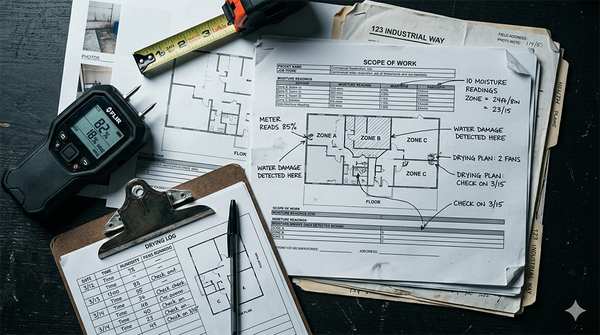
Scoping requires field judgment. Category and Class determination under IICRC S500 involves physical assessment, material identification, and contamination evaluation that no intake form captures completely.
The tech who opened a wall cavity and found conditions that escalated the loss from Category 1 to Category 3 is not filling out a structured data entry form. They are making a judgment call with financial consequences that flow through the entire estimate. An AI tool that does not account for that field reality will produce scopes that are fast and wrong.
Documentation has compliance stakes. Drying logs, moisture mapping records, and equipment rationale are not just internal tracking. They are the evidentiary record that defends the scope to the carrier and, in disputed claims, to an appraiser or umpire. A documentation workflow that produces faster output at the cost of audit readiness has not improved the operation. It has moved the risk downstream.
These are legitimate constraints. They explain why the solutions that work in estimating are not the same as the solutions that work in email drafting. They also explain why the companies that have cracked this are not using generic AI tools the same way they use them for writing tasks. They are using AI configured around the specific inputs, structure, and compliance requirements of restoration scope work.
Ready to figure out which workflows in your operation are the right candidates for AI? A free AI strategy call is a focused conversation about where friction lives in your specific workflows before any tool gets selected.
What Companies on the Right Side Are Actually Doing
The report's observation that the gap is still small but grows every year is the part most operators read past. Small and growing is the most dangerous kind of competitive disadvantage because it does not feel urgent until it is. The companies that are building operational advantage through AI right now are not doing it with tools that are unavailable to anyone else. They are asking a different question before they touch the tool.
The distinction worth holding onto is this: the companies pulling ahead are not automation-first. They are operational intelligence first. Automation, where it applies, comes later and selectively.
What comes first is the question: which specific workflow is costing us the most time or margin right now, and what does AI look like inside it? That sequencing is what separates the companies compounding an advantage from the ones still standing in the entryway. The tool is not the starting point. The operational problem is.
What this looks like in practice is narrower than most AI conversations suggest. It is not a full operational transformation. It is not a new platform with a six-month implementation. It is a single workflow problem, addressed deliberately, with a 90-day window to see whether the intervention produces a measurable result. The report's own advice on this is direct: pick one operational problem that costs time or money every week and spend 90 days trying to solve it with AI.
The workflows that produce the most return in restoration tend to share a common profile:
High-frequency. They happen on every job or nearly every job, which means any time recovered compounds across the entire pipeline rather than applying to an occasional edge case.
Documentation-heavy. They require retrieving, organizing, and structuring information that already exists somewhere but takes manual effort to assemble. The AI reduces the friction before the decision, not the decision itself.
Human judgment at the end. The estimator or PM still owns the output. What the AI removes is the work that precedes the judgment call, not the judgment call itself.
Scope development, carrier communication prep, and documentation review all fit that profile. None of them require removing the estimator or PM from the workflow. They require reducing what that person has to do before they can apply the expertise that matters. That is the model described in detail in why human-in-the-loop AI outperforms full automation for restoration operations, and it is the model the most operationally mature companies in this space are running.
The report notes that vendors should be able to offer three to five times the value they were providing a few years ago because of AI. That is a useful filter for evaluating your current software stack. It is also a useful frame for evaluating where your own operation has room to move.
The companies getting ahead are not necessarily buying new tools. Many are getting more out of the tools and workflows they already have by building a clearer AI layer inside them.
Starting that process begins with an honest look at where your workflows are burning capacity that your operators should not have to spend. That clarity, as the AI implementation strategy work makes clear, comes before the tool selection and shapes everything that follows.
Frequently Asked Questions About AI Adoption in Restoration
Is the restoration industry behind on AI adoption compared to other trades?
The restoration industry is not behind on AI sentiment, but it is behind on operational deployment. At 84% open to or embracing AI, the industry's attitude toward the technology is more favorable than many comparable trades.
The deployment gap, where most companies are still using AI primarily for writing tasks rather than embedding it in estimating, documentation, or workflow operations, is consistent with what other field service industries show at this stage of adoption.
The difference in restoration is that the stakes of closing that gap are higher, because the workflows where AI produces the most value are also the workflows most directly tied to how fast and how fully a company gets paid.
What is the difference between using AI as a productivity tool and using it as operational infrastructure?
A productivity tool reduces the time it takes to do a task you were already doing. AI as a writing assistant is a productivity tool. It makes emails faster. Operational infrastructure changes the structure of how work moves through the business.
AI embedded in a scope development workflow is not just making the estimator faster at a task they were already doing. It is changing what the estimator has to do before they can apply their judgment, collapsing the retrieval and formatting work that precedes the decision rather than speeding up the decision itself. Productivity tools produce marginal gains. Operational infrastructure produces compounding ones.
Where should a restoration company start if they want to move beyond AI for email?
Start with the workflow that costs the most time or margin every week, not the one that seems most technically straightforward to automate.
For many restoration companies, that workflow lives in estimating and documentation: the gap between field assessment and a complete, carrier-ready scope. Map what that workflow looks like today:
Where does information get lost or delayed between the field team and the estimator?
Where is the estimator doing work that does not require their judgment?
Where do scope errors most commonly originate, and how far into the job do they surface?
That diagnostic work is what makes AI tool selection productive rather than speculative. Without it, any tool you add will get used for the obvious task and ignored for everything else.
What does the 2026 State of the Industry report say about AI in restoration?
The 2026 C&R/KnowHow State of the Industry report found that 84% of restoration companies are open to or fully embracing AI, up from roughly 70% three years ago. Despite that sentiment, email writing remains the dominant use case for the third consecutive year.
The report identifies a widening gap between companies using AI as a writing tool and companies building real operational infrastructure, and describes that gap as competitive. It found that 36% of restorers most want to improve estimating and job site documentation with AI, while simultaneously concluding that deployment in that department has barely moved.
The report's recommendation: pick one operational problem that costs time or money every week and spend 90 days trying to solve it with AI rather than continuing to treat the technology as a writing assistant.
The Bottom Line
The 2026 State of the Industry report gives restoration operators something most AI coverage does not: an honest picture of where the industry actually is, not where the vendors say it should be.
Eighty-four percent open to AI. Email writing still dominant after three years. The highest-value workflows, estimating and documentation, largely untouched.
The gap between companies using AI as a writing tool and companies building operational infrastructure is real, and it compounds quietly.
The action worth taking is not finding a better tool. It is identifying the single workflow in your operation that costs the most time or margin every week, and spending 90 days building something deliberate around it.
What This Means for Your Operation
The data from the 2026 report is useful not because it tells restoration operators something they did not already sense, but because it confirms it with numbers.
Most companies are open to AI. Most are using it for the same low-leverage task. And the workflows where AI produces the most value, the ones your estimators and PMs live in every day, are the ones where deployment has barely moved.
That is not a technology problem. The tools exist. The access is not the constraint. What is missing for most companies is the operational clarity that makes AI deployment purposeful rather than speculative.
The companies pulling ahead are not doing something exotic. They identified one high-frequency, documentation-heavy workflow, built a deliberate AI layer inside it, and measured the result. That is a replicable pattern. It does not require a large team, a long implementation, or a vendor relationship. It requires knowing which workflow to start with.
If you are already experimenting with AI for contractors in your operation and want to move beyond the email stage, the human-in-the-loop AI model is the most practical framework for doing it without rebuilding how your team works.
The operators getting results from it are not removing judgment from their workflows. They are removing the friction that slows judgment down.
The gap is still small. That is the window.
Wondering where your operation falls in this gap and which workflows are worth tackling first? The Restoration Growth Blueprint is a structured operational audit for restoration companies that want to understand where time and margin are leaking before deciding what to fix.
Jim West is a digital operations specialist and MIT-certified AI strategist who helps restoration companies identify where time, margin, and energy are lost in daily operations. He helps teams simplify systems and work with less friction.