Why Human-in-the-Loop AI Outperforms Full Automation for Restoration Operations
Full automation struggles in restoration because no two jobs follow the same path. Here is why the human-in-the-loop AI model produces better adoption, better output quality, and more sustainable ROI for restoration operations.
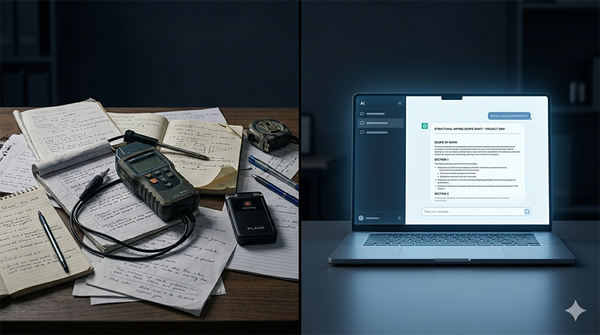
Human-in-the-loop AI keeps humans actively involved in AI-assisted workflows rather than handing decisions over to fully automated systems.
For restoration operations, where no two jobs follow the same path and field conditions change daily, this approach produces better results than full automation because the AI handles retrieval, structure, and repetitive reasoning while the PM, estimator, or ops manager provides the judgment that automation cannot replicate.
At a Glance
Most restoration companies chasing AI ROI are aiming at the wrong target. Full automation works when workflows are stable, predictable, and low-judgment. Restoration operations are none of those things.
The human-in-the-loop model, where AI reduces friction while humans retain decision authority, produces faster adoption, better output quality, and more sustainable value than automation-first deployments in this industry. The goal is not to remove humans from the operation. It is to remove the friction that slows them down.
The conversations happening inside restoration companies right now tend to go one of two ways. Either someone is trying to automate everything, building complex multi-step workflows that promise to run the business while the owner sleeps. Or someone has tried that, watched it fall apart on the third exception, and quietly gone back to spreadsheets.
Both outcomes miss the actual opportunity.
Understanding how AI workflow automation works inside restoration operations starts with a more honest question: which parts of your workflow benefit from removing the human, and which parts fall apart the moment you do? The answer, for most restoration companies, is more nuanced than the vendors let on. Some tasks automate cleanly. Most do not. And the ones that do not share something in common.
Restoration work is dynamic in a way that most automation architectures are not built to handle. Jobs change mid-stream. Field conditions introduce variables no intake form captured. Carriers push back on scopes that were documented correctly but not communicated clearly. Category determinations shift when a tech opens a wall cavity and finds what was not visible from the surface. These are not edge cases. They are Tuesday.
The human-in-the-loop model exists precisely for this environment. It keeps the operator in the decision seat while collapsing the friction that burns through capacity every day. That is a fundamentally different objective than automation, and it produces fundamentally different results.
What "Human-in-the-Loop" Actually Means (And What It Doesn't)
Human-in-the-loop AI, often shortened to HITL, is a design approach where humans remain actively involved at key points in an AI-assisted workflow.
The AI processes information, generates output, or proposes an action, and the human reviews, adjusts, or approves before the work moves forward. IBM defines it as humans being involved at key points in the AI workflow to ensure accuracy, safety, accountability, and ethical decision-making. That definition holds for enterprise ML systems. In restoration operations, the practical meaning is simpler: the AI does the heavy lifting on information retrieval and structure, and the operator decides what to do with it.
It is worth separating this from two things it’s often confused with. The first is full automation, where the system executes a workflow start to finish without human involvement. That model works well for structured, rule-based tasks with predictable inputs.
The second is human-on-the-loop, where a human monitors an automated system and can intervene if something goes wrong. That is a supervisory posture. Human-in-the-loop is a collaborative one. The human is not watching from the sidelines. They are part of the workflow at the points where judgment matters.