The Hidden Cost of Running Your Restoration Business Across Disconnected Systems
Ask most restoration owners which active jobs are profitable right now. The answer gets complicated fast. Not because they aren't paying attention. Because the systems holding that answer were never designed to give it to them.
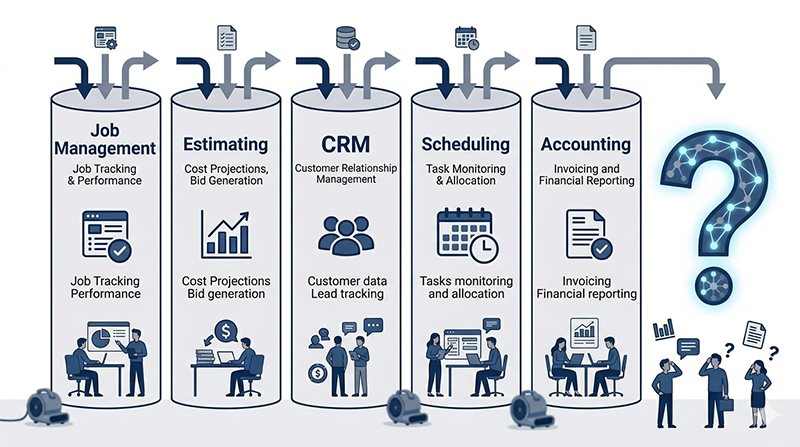
Running a restoration business across multiple disconnected systems doesn't just create extra work. It creates operational blind spots that hide job profitability problems, extend claim cycles, and make it nearly impossible for ownership to see where time and margin are actually going.
At a Glance
Most restoration companies running five or more tools aren't suffering from too much software. They're suffering from the absence of a designed information flow that connects intake to closeout and gives leadership a clear picture of what's happening inside the business. When data lives in a job management platform, an estimating tool, a CRM, a scheduling system, and an accounting package that never talk to each other, the result isn't just duplicate entry. It's a business where profitability is only visible in hindsight, bottlenecks don't surface until they've already cost money, and every operational decision gets made on instinct rather than information.
Most restoration owners who reach a certain size can tell you exactly how many active jobs they're running. Ask them which ones are profitable right now, and the answer gets complicated fast.
It's not that they aren't paying attention. It's that the information needed to answer that question is scattered across systems that were never designed to talk to each other. The job management platform knows what's been scheduled. The estimating software knows what's been scoped. QuickBooks knows what's been invoiced. But none of them know what the others know, and nobody has a complete picture without pulling data from three places and doing the math manually.
This is one of the most common operational patterns in restoration companies that have grown past the point where one person can hold everything in their head. The tools are good. The people are capable. The workflow connecting them was never designed to produce visibility, so it doesn't.
The result isn't chaos in the traditional sense. Jobs get completed. Customers get served. Invoices go out. But the business is flying on instinct at the exact moment it needs to be flying on information, and the cost of that gap shows up in ways that are easy to miss until they've already done damage.
The Systems Aren't the Problem
Most restoration companies didn't end up with five or six software tools because someone made a bad decision. They ended up there because each tool solved a real problem at the time it was added.
A scheduling platform because dispatching jobs on a whiteboard stopped working. A CRM because referral relationships were falling through the cracks. A job management platform because active jobs needed structure. Each addition made sense in isolation.
The problem isn't the tools. It's that nobody ever designed how information would move between them.
What triggers most software conversations in restoration isn't bad software. It's the absence of a designed information flow connecting the tools that already exist.
That's a meaningful distinction. When a restoration company owner says their systems are slowing them down, what they're usually describing isn't a software failure. They're describing a workflow architecture that was never built. Data gets captured in one place, manually re-entered in another, and the two records drift apart over time. The information exists. The clarity doesn't.
When Good Tools Produce Bad Visibility
A job management platform does exactly what it's designed to do: track jobs. A CRM manages contacts and pipeline. An estimating tool produces estimates. Each system is competent inside its own boundaries. The visibility problem starts at the boundaries, in the handoffs between systems where data should flow automatically but doesn't.
A project manager checks the job management platform for active job status. The estimator works in Xactimate. The office manager updates QuickBooks when invoices go out. The owner wants to know which jobs are profitable right now.
To answer that question, someone has to pull information from at least three of those systems, reconcile the numbers manually, and hope nothing has changed since the last time they looked.
That process works until the company gets busy. Then it becomes the first thing that slips.
The Difference Between Capturing Data and Having Clarity
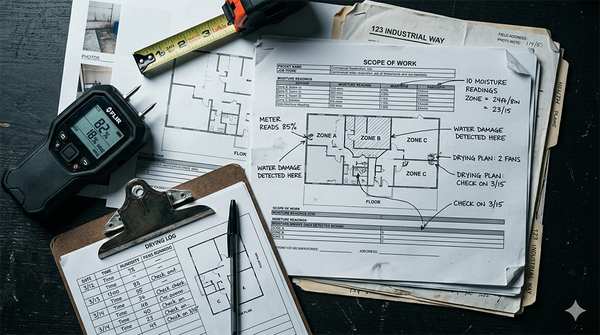
Restoration is one of the most data-intensive trades in the field service industry. Under IICRC documentation standards, a single water loss requires psychrometric readings, daily drying logs, moisture mapping across all affected areas, photo documentation, and a scope of work that justifies every line item in the estimate.
That's a significant volume of data generated per job, per day, across an active job board that might have twenty or thirty open files at once.
Capturing that data is not the same as having clarity about the business. A company can be fully compliant with IICRC S500, produce thorough documentation on every job, and still have no clear picture of which jobs are running over budget, which project managers are losing time to coordination problems, or where claim cycles are stalling.
The documentation serves the insurance process. It doesn't automatically serve the operational intelligence needs of the owner.
Clarity requires something different. It requires that the data captured across all those systems gets connected in a way that answers the questions ownership actually needs answered, not just the questions each individual tool was built to answer.
What Disconnected Systems Actually Cost
There's a version of this problem that's easy to see: the office manager re-entering the same job address into four different systems before noon. That's visible, frustrating, and easy to point to.
The harder version is the cost that never shows up on a report because the report was never built to capture it.
Disconnected systems don't just create extra work. They create a specific kind of financial exposure that compounds quietly across every job on the board.
The Profitability You Can't See Until It's Gone
Job profitability in restoration isn't a single number that lives in one place. It's the difference between what was estimated, what was actually performed, what was billed, and what was collected. Those four figures often live in four different systems with no automatic reconciliation between them.
An estimator scopes a Category 2 water loss at $14,000. The field team performs three additional days of drying because initial moisture readings were worse than the walkthrough suggested. The supplement gets written but sits in a queue. The job closes.
QuickBooks shows an invoice for the original estimate amount. The owner sees revenue. Nobody sees the $1,800 that didn't get billed because the supplement never made it from the field team's notes into Xactimate and out to the carrier before the file closed.
That's not a documentation failure in isolation. It's what happens when the information flow between field documentation, scope writing, and billing was never designed to catch that gap automatically. As the Restoration Industry Association has noted, operational inefficiency in mid-size restoration companies rarely stems from a single systemic failure. It accumulates in the handoffs.
Multiply that pattern across sixty to seventy jobs a month and the margin leakage becomes significant. Not because anyone made a bad decision, but because the architecture wasn't built to surface the problem while there was still time to fix it.
Profitability isn't invisible because the data doesn't exist. It's invisible because the data lives in systems that were never connected to show it.
Ready to see where your operation is losing time and margin? The Restoration Growth Blueprint is a structured operational audit that identifies where friction lives before you decide what to fix.
How Cycle Time Delays Hide in the Gaps Between Systems
Claim cycle time is one of the clearest indicators of operational health in a restoration company. Carriers watch it. TPAs measure it. And most restoration owners have a rough sense of their average. But very few can tell you where in the cycle the time is actually going.
The delay rarely lives where it looks like it lives. A job that takes eleven days to close when it should take seven isn't usually sitting idle in the field. It's waiting.
Waiting for a scope that can't be written because moisture readings haven't been logged. Waiting for an invoice that can't go out because the estimate hasn't been finalized. Waiting for an adjuster response that never got followed up because the task to follow up wasn't connected to the job status in any system anyone checks daily.
Each of those waits lives in the gap between systems. The job management platform shows the job is active. The estimating software shows the estimate is in progress. Nobody sees the three-day window where nothing moved because the handoff between field documentation and scope writing had no trigger, no owner, and no visibility.
This is where documentation gaps that start upstream do their real damage. Not in the estimate itself, but in the cycle time that erodes while the information needed to move the job forward sits uncaptured in a platform that doesn't talk to the one where the work gets done.
The cost isn't just the delayed payment. It's the carrying cost of an open job, the crew availability tied up in a file that should be closing, and the operational overhead of managing a job board that's longer than it needs to be.
What Operational Clarity Actually Looks Like
Operational clarity isn't a dashboard. It's not a reporting module or a new software subscription. It's the condition where the questions ownership needs to answer about the business can actually be answered, in time to act on them.
That distinction matters because a lot of restoration companies have pursued clarity by adding tools, and ended up with more data and less visibility than when they started. A new platform doesn't produce clarity if the workflow feeding it was never designed to produce the right information in the right sequence. The output is only as coherent as the process behind it.
Clarity is an architectural outcome. It comes from designing how work flows through the business before deciding what captures it.
From Reactive Decisions to Informed Ones
The most reliable signal that a restoration company lacks operational clarity isn't a single dramatic failure. It's the pattern of decisions that get made without the information to make them well.
A project manager assigns a crew to a job without knowing that crew spent the last two days running over hours on a fire loss that still isn't closed. An owner approves overhead spending in a slow month without knowing three jobs on the board are sitting on unbilled supplements that haven't moved in two weeks. An estimator writes a scope based on a field report that was entered into one system but never reconciled with the moisture data sitting in another.
None of these are careless decisions. They're uninformed ones.
The difference between a restoration company that compounds margin over time and one that treads water often comes down to how frequently leadership is making decisions with complete information versus incomplete information.
Operational clarity changes that ratio. When the workflow is designed to move the right data to the right place at the right time, the decisions that used to require a manual audit happen as a matter of course. A PM checks one place instead of three. An owner's morning review shows job status, estimated versus actual costs, and open billing items without anyone having to compile the report. The business becomes readable.
The goal isn't more data. It's a workflow designed so the data that already exists answers the questions that actually matter.
The Restoration Project Management Problem No Software Solves Alone
Restoration project management is fundamentally a coordination problem. A project manager on an active job board isn't just tracking task completion. They're managing information flow between the field team documenting conditions, the estimator translating those conditions into a billable scope, the office coordinating carrier communication, and the owner trying to understand where each job stands financially.
When those roles operate inside connected systems, a PM can spend their time managing the work. When they operate inside disconnected ones, a significant portion of every day goes to managing the information gap instead.
Chasing field reports that didn't make it into the job management platform. Reconciling equipment logs against what was billed. Following up on supplements that got written but never tracked to resolution.
That's not a project management failure. That's what happens when the architecture puts coordination burden on the person instead of the system. As research on operational decision-making in field service businesses consistently shows, the companies that scale without proportionally growing their overhead are the ones that design information flow into the process rather than relying on individuals to compensate for the gaps.
The software doesn't solve this alone. The workflow design has to come first. A project manager inside a well-designed restoration workflow, one where field data triggers scope development, scope completion triggers billing, and billing status is visible to ownership without a manual pull, operates at a fundamentally different capacity than one compensating for system gaps all day.
That's the restoration project management problem worth solving. Not which platform to use, but how the work flows between the people and systems that already exist.
When the Data Finally Connects
There's a specific moment that restoration owners who have solved this problem tend to describe in similar terms. It's not the moment they bought new software or hired a new operations manager. It's the moment they could open a single view of the business and actually see what was happening across every active job without making three phone calls first.
That moment is an architectural outcome, not a technology purchase.
When the information flow between field documentation, scope development, billing, and job status is designed rather than improvised, the operational picture changes in concrete ways.
A job running over on labor shows up before closeout, not after. A supplement sitting idle for five days surfaces as an open item rather than disappearing into a queue. An owner reviewing the morning's job board sees estimated versus actual costs per file without anyone having to compile the data manually.
The business becomes something that can be read clearly, in real time, by the people who need to make decisions about it.
When operational data connects across the workflow, the questions that used to require a manual audit start answering themselves.
That's not a description of a specific platform or reporting tool. It's a description of what becomes possible when the workflow was designed to produce visibility from the start. The technology that surfaces it, whether that's a connected intelligence layer across existing systems, a unified job management platform, or a purpose-built operational dashboard, is a downstream decision. The upstream decision is the workflow architecture that makes any of those tools worth using.
The restoration companies that get there don't necessarily have better software than the ones still flying on instinct. They have a clearer picture of how information should move through their operation, and they built their systems around that picture instead of the other way around.
The instinct when operational visibility is low is to look for a tool that provides it. A better dashboard. A more integrated platform. A reporting module that pulls everything together.
That instinct isn't wrong, but the sequence usually is.
A tool built on top of an undesigned workflow produces a cleaner view of the same confusion. The data comes in faster. The gaps show up more clearly. But the underlying problem, that information flow between roles and systems was never architected to produce visibility, doesn't get solved by adding another layer on top of it.
The starting point is the workflow audit, not the software search.
Before any platform decision, consolidation effort, or integration project, the most useful thing a restoration company can do is map how information actually moves through the business today. Not how it should move. How it does.
Where does job data first get captured, and what triggers its movement to the next system? Where do handoffs between field and office depend on a person remembering to do something rather than a process that makes it automatic?
Where does the information needed to answer a profitability question actually live, and how many manual steps does it take to assemble it?
Those questions don't require new software to answer. They require honest observation of the workflow that exists. And the answers almost always reveal that the problem isn't which tools the business is running. It's that the connective tissue between them was never designed.
That's the work that makes everything downstream more effective. The platform evaluation, the integration decision, the AI implementation, all of it. Clarity precedes automation. It also precedes consolidation, migration, and every other operational improvement that depends on information moving reliably through the business.
The software search is the wrong first step. The workflow audit is the right one.
Ready to see where your operation is losing time and margin? The Restoration Growth Blueprint is a structured operational audit for restoration companies that want to understand where friction lives before deciding what to fix.
Frequently Asked Questions About Restoration Operations and Disconnected Systems
What is restoration project management and why does it affect profitability?
Restoration project management is the coordination of people, documentation, equipment, and information across every phase of a damage restoration job, from intake and field assessment through scope development, drying, and final closeout. It directly affects profitability because the speed and accuracy of that coordination determines how quickly jobs close, how completely work gets billed, and how much overhead gets consumed managing gaps between phases.
A project manager operating inside a well-designed workflow closes jobs faster and captures more billable work than one spending significant time bridging information gaps between systems that don't communicate. The difference shows up in margin, not just efficiency.
Why do restoration companies struggle with job profitability visibility?
Most restoration companies struggle with job profitability visibility because the data that would produce it is distributed across systems that were never connected. Estimated costs live in Xactimate. Actual labor hours live in a scheduling or time-tracking platform. Invoices and expenses live in QuickBooks. Supplement status lives in email threads or a job management platform.
No single system holds all four, and most companies have no automated process that reconciles them. The result is that true job profitability only becomes visible at closeout, after the window to act on it has passed.
What does operational clarity mean for a restoration company?
Operational clarity means the questions ownership needs to answer about the business can be answered in time to act on them. Which jobs are running over budget right now. Where claim cycle delays are accumulating. Which open files have unbilled work sitting in them.
A restoration company with operational clarity doesn't need a manual audit to answer those questions. The workflow was designed to surface that information as a matter of course. Operational clarity is an architectural outcome, not a software feature. It comes from designing how information moves through the business before deciding what tools capture it.
How do disconnected systems affect restoration workflow efficiency?
Disconnected systems affect restoration workflow efficiency primarily by placing coordination burden on people instead of processes. When field documentation, scope writing, job management, and billing operate in separate platforms with no automatic data flow between them, someone has to manually bridge every gap.
That means re-entering job data across multiple systems, reconciling records that have drifted apart, and chasing information that should have moved automatically. The overhead isn't just the time spent on duplicate entry. It's the decision-making that slows down because the information needed to make good decisions isn't available without a manual pull.
What does it look like when a restoration company has connected operational data?
When operational data connects across a restoration workflow, the business becomes readable in real time rather than in hindsight. Job profitability is visible mid-job, not just at closeout. Cycle time delays surface in days rather than weeks. Open billing items appear as actionable tasks rather than disappearing into a queue.
Ownership can review the morning's job board and understand estimated versus actual costs per file without anyone having to compile a report. That condition isn't the product of any single platform. It's the result of a workflow designed to move the right information to the right place at the right time, with technology serving the architecture rather than substituting for it.
The Bottom Line
Restoration companies that struggle with operational visibility rarely have a software problem. They have a workflow architecture problem, one that more tools won't fix and better tools won't prevent. The data exists. The systems are often capable. What's missing is the designed information flow that connects them and makes the business readable in real time.
The starting point isn't a platform evaluation. It's an honest look at how information actually moves through the operation today, where it gets captured, where it stalls, where it disappears into a gap between systems, and what it costs when it does. That audit is the work that makes every downstream decision more effective, whether that's an integration project, a platform consolidation, or an AI implementation.
Clarity precedes all of it.
Conclusion
The restoration companies that grow without losing control of their margins aren't necessarily running better software than everyone else. They're running a better-designed operation, one where the information flow was thought through before the tools were selected, and where the workflow itself produces the visibility that ownership needs to make good decisions.
That's not a technology problem. It's a clarity problem. And it's one that shows up at a predictable point in a restoration company's growth: the moment the business gets complex enough that one person can no longer hold the full operational picture in their head, but the systems haven't been designed to hold it instead.
If that description fits where your company is right now, the next step isn't a software evaluation. It's an honest look at how work actually flows through your business, where the information that should move between roles and systems is stalling, where decisions are being made on instinct because the data to make them well isn't accessible, and what it's costing you in margin and cycle time every month that the architecture stays unaddressed.
Not Sure Where AI Fits in Your Operations? If you’re unsure whether your workflows are ready for structured AI adoption, start with clarity, not tools.
Jim West is a digital operations specialist and MIT-certified AI strategist who helps restoration companies identify where time, margin, and energy are lost in daily operations. He helps teams simplify systems and work with less friction.