Last Updated: April 25, 2026

Moisture mapping is the systematic process of measuring, recording, and tracking moisture levels across all affected materials in a water-damaged structure. Done correctly, it produces documentation that justifies your scope, defends your drying timeline, and survives adjuster review from initial assessment through verified dry standard.

What You Need to Know

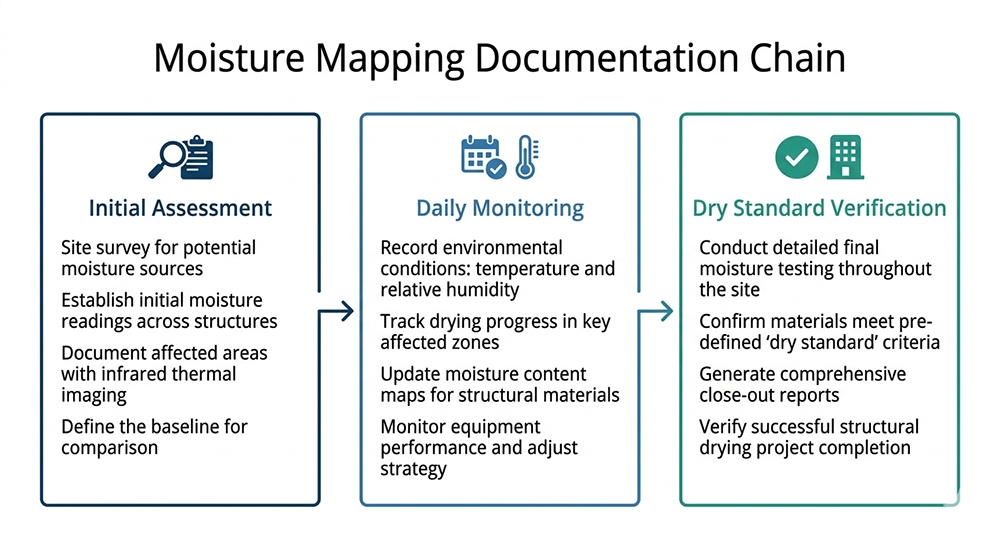
Moisture mapping is not a single task. It is a documentation chain that starts at first contact and does not close until materials return to dry standard. A defensible moisture map requires three things:

  1. Baseline readings across all affected and adjacent unaffected areas
  2. Daily psychrometric data tied to drying progress
  3. A final verification pass confirming materials reached equilibrium moisture content

The most common reason moisture mapping fails insurance scrutiny is not tool selection or technique. It is gaps in the chain: missing baseline readings, incomplete coverage of secondary moisture migration areas, or a closeout file that shows drying equipment was deployed but never proves the work is done.

Carriers are increasingly using automated systems to scan submitted claim files for exactly these gaps, which means the documentation bar is rising whether your team knows it or not.

Most restoration companies understand that moisture mapping matters. Where things break down is in treating it as a field task rather than a documentation system.

A technician who takes readings at initial assessment and again at closeout has captured two data points. That is not a moisture map. It is a before-and-after snapshot with nothing in between to show how drying progressed, what equipment was running, what the psychrometric conditions were each day, or when materials actually crossed the dry standard threshold.

An adjuster reviewing that file has no story to follow. And a file without a story is a file that gets questioned.

The documentation problems that appear in moisture mapping are almost always workflow problems first. The field team is doing the work. The readings are being taken. But the system for capturing, organizing, and connecting that data into a defensible chain breaks down somewhere between the job site and the closeout file.

That is what this post addresses.

moisture mapping documentation chain for insurance-ready water damage claims

Moisture mapping is not a single task. It is a documentation chain that starts at first contact and does not close until materials return to dry standard. A defensible moisture map requires three things:

  1. Baseline readings across all affected and adjacent unaffected areas
  2. Daily psychrometric data tied to drying progress
  3. A final verification pass confirming materials reached equilibrium moisture content

What Moisture Mapping Actually Requires Under IICRC S500

The Difference Between a Moisture Reading and a
Moisture Map

A moisture reading is a single data point. A moisture map is a system.

Taking a pin meter reading on a wet drywall section tells you the moisture content at that spot, at that moment. It tells you nothing about how far the moisture has traveled, what the adjacent materials are doing, or whether the unaffected areas nearby are actually unaffected.

A moisture map connects those data points into a spatial record. It shows where the water went, how far it migrated, which materials absorbed it and which ones did not, and how all of that changed day by day as drying progressed. That is the document an adjuster uses to evaluate whether your scope was justified and whether your drying timeline was reasonable.

The distinction matters because most documentation failures are not about individual readings being wrong. They are about the readings never getting organized into a coherent spatial record in the first place.

If it happened in the field but it is not on the map, it did not happen as far as the insurance file is concerned.

What S500 Requires Across Assessment, Monitoring, and Closeout

The IICRC S500 Standard for Professional Water Damage Restoration requires systematic assessment and documentation of moisture levels throughout the affected structure, with obligations organized across three distinct phases. Moisture mapping is the process by which those obligations are fulfilled, from initial boundary identification through final drying verification.

Phase 1: Initial Assessment

  • The initial assessment establishes the documentation baseline that everything else is measured against. S500 requires:
  • Identification and classification of the water source (Category 1, 2, or 3)
  • Determination of the water damage class (Class 1 through 4) based on evaporation rate and affected material volume
  • Moisture readings in all affected materials, with comparison readings taken in unaffected areas to establish dry standard reference points
  • Documentation of affected versus unaffected boundaries, including secondary migration areas beyond the visible wet zone

That last point is where most initial assessments fall short. Water does not stop at the wall it came through. It wicks into adjacent framing, travels along subfloor seams, and migrates through wall cavities in directions that are not immediately visible. An initial map that only documents what is visibly wet at day one is already incomplete.

Phase 2: Daily Monitoring
S500 requires ongoing moisture content measurements throughout the drying period, documented no later than the day following initiation of drying and daily thereafter. This is not optional, and it is not satisfied by a photo of equipment running.

Each daily monitoring entry needs to capture:

  • Moisture content readings in affected materials at consistent measurement points
  • Temperature and relative humidity inside the drying chamber
  • Temperature and relative humidity outside the drying chamber
  • Grains per pound (GPP) differential between interior and exterior conditions
  • Equipment inventory, placement, and operational status

Declining interior GPP is the psychrometric signal that tells you drying is progressing. A healthy drying system shows interior GPP dropping each day as moisture is removed from the affected area.

When interior GPP flattens or rises across consecutive readings, something is wrong: insufficient dehumidification capacity, hidden moisture the map missed, or containment failure. Daily documentation catches those signals. Weekly check-ins do not.

Phase 3: Closeout Verification
This is the phase most restoration files handle poorly. Not because the work is not done, but because the documentation does not prove it. S500 requires documented confirmation that materials have returned to dry standard before the drying phase is closed.

Dry standard is not a fixed number. It is the moisture content of similar unaffected materials in the same structure under the same ambient conditions. The closeout document needs to show the comparison: final readings in previously affected materials measured against the established dry standard from unaffected reference areas.

A closeout file that shows "equipment removed on Day 7" without final moisture readings leaves the adjuster to assume the work is complete. That assumption does not always hold. And when it gets challenged, the contractor has no data to defend the timeline.

IICRC S500 moisture mapping documentation requirements across three phases

The Tools Behind a Defensible Map

Penetrating Meters, Non-Penetrating Meters, and
When Each Applies

Most technicians carry both types and know the basics. The documentation problem is not usually which meter gets used. It is understanding what each one actually measures, and where relying on one type alone creates gaps that show up later in an adjuster review.

Penetrating (pin) meters drive two small probes into the material surface and measure electrical resistance between them. Moisture conducts electricity; resistance drops as moisture content rises. Pin meters give you a direct moisture content reading at the probe depth, typically expressed as a percentage.
They are the right tool when you need:

  • Confirmed moisture content in wood framing, subfloor, or structural members
  • Verification of readings flagged by a non-penetrating scan
  • Documentation of specific material moisture content for S500 compliance

The limitation worth knowing: standard pin probes measure moisture content at the contact depth. On thick substrates, that reading reflects what is happening near the surface, not deeper in the assembly.

A 3/4-inch hardwood floor over a 3/4-inch plywood subfloor can show acceptable surface readings while moisture migrates through the subfloor and into the framing beneath. That is not a meter failure. It is a documentation gap that needs to be addressed with deeper probe attachments or secondary verification tools.

Non-penetrating (pinless) meters use electromagnetic signals to scan material moisture content without breaking the surface. They cover ground faster and work well for initial assessment sweeps to identify wet zones before taking pin readings at specific locations.

They are the right tool when you need:

  • Rapid boundary mapping across large surface areas
  • Non-destructive scanning of finished surfaces like hardwood flooring
  • Identifying secondary migration zones that are not visibly wet

The limitation: pinless meters are detection tools, not precision documentation instruments. Readings vary with material density, backing layers, and surface temperature. A pinless scan that identifies a wet zone needs to be followed by pin meter confirmation before that reading goes into the insurance file.

Neither meter type alone produces a defensible moisture map. The documentation chain requires both, deployed in sequence, with each reading labeled by tool type, location, and timestamp.

Thermal Imaging as a Detection Tool, Not a Documentation Tool


Thermal imaging cameras detect surface temperature differences, not moisture content. That distinction matters more than most documentation protocols reflect.

When water evaporates from a material surface, it draws heat away from that surface. The result is a cooler temperature signature that shows up as a distinct color band on an infrared image. Thermal cameras identify those signatures across large surface areas quickly, which makes them valuable for locating hidden moisture migration behind walls, under flooring, and above ceilings.

What thermal imaging does not do is give you a moisture content reading. A thermal image shows you where to look. It does not tell you how wet the material is, what category the water is, or whether the moisture level has crossed the threshold that requires remediation.

The documentation implication is straightforward:

  • Thermal images belong in the claim file as detection evidence, not as documentation of moisture content
  • Every thermal anomaly identified during assessment needs to be followed by direct meter readings at that location
  • Thermal images without paired meter readings give the adjuster a picture of a potential problem, not proof of its extent

Used correctly, thermal imaging is one of the most effective tools for catching secondary migration that manual spot-checking would miss.

A ceiling cavity that shows no visible water damage and no surface wet spots may show a clear thermal signature from water that traveled along a joist and pooled above the drywall. That finding, documented with a thermal image and confirmed with pin meter readings after careful access, becomes a defensible scope expansion. Without the thermal image, that moisture goes unmapped until it causes secondary damage weeks later.

Psychrometric Instruments and Daily Drying Log Data

The daily drying log is where most moisture mapping documentation either holds together or falls apart.

Moisture content readings alone do not explain a drying timeline. An adjuster reviewing a file that shows moisture at 22% on Day 1 and 11% on Day 7 has no way to evaluate whether that drying rate was appropriate, insufficient, or artificially extended. The psychrometric data is what provides that context.

A calibrated thermo-hygrometer captures the ambient conditions that drive or impede drying. Every daily log entry needs to record:

•      Interior temperature inside the drying chamber

•      Interior relative humidity inside the drying chamber

•      Exterior temperature outside the affected area

•      Exterior relative humidity outside the affected area

•      Grains per pound (GPP) for both interior and exterior conditions

The trend in interior GPP tells the story the moisture readings alone cannot. When interior GPP is dropping each day, the drying system is performing. When that trend stalls, something is wrong: insufficient dehumidification, a hidden moisture source the map missed, or a containment breach. That signal, documented daily, gives you a data-backed explanation for every day of equipment runtime.

It is also what the IICRC S500 approach to initial equipment usage establishes as the standard for defensible drying documentation, because GPP differential is the objective measure of whether the equipment you deployed was performing the work you billed for.

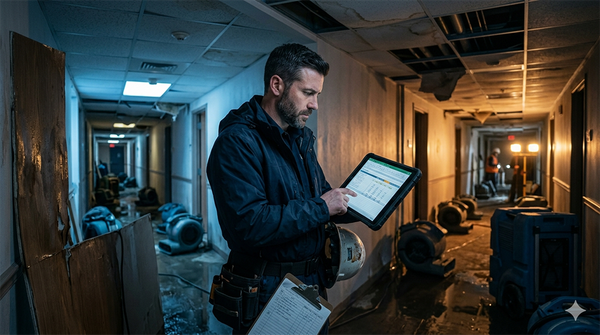
moisture mapping tool comparison for water damage restoration documentation

Building the Documentation Chain From Day One

Baseline Documentation: What to Capture Before Drying Equipment Goes In

The single most damaging documentation gap in water damage restoration happens before a single piece of drying equipment is placed. It is the missing baseline.

A baseline is not a photo of the wet area. It is a set of calibrated moisture content readings, room by room, material by material, that establish the starting condition of the loss before drying begins. Without it, you have no reference point.

You cannot prove how wet materials were at day one, you cannot demonstrate drying progress against a starting condition, and you cannot defend the drying timeline when an adjuster asks why the job ran seven days instead of four.

Before equipment goes in, capture the following at every loss regardless of size:

  • Moisture content readings in all visibly affected materials, labeled by room, material type, and measurement location
  • Moisture content readings in adjacent unaffected materials to establish the dry standard reference for that structure
  • Category and Class determination documented with the rationale, not just the classification number
  • Thermal imaging sweep of affected and adjacent areas to identify secondary migration zones that are not visibly wet
  • Ambient conditions: temperature and relative humidity inside and outside the affected area
  • Photographic documentation of each reading location, tied to a floor plan sketch showing measurement points

 That floor plan is not optional. A list of readings with no spatial reference tells an adjuster nothing about coverage. A floor plan with labeled measurement points shows exactly where you looked, what you found, and what the boundaries of the affected area were on day one.

Water does not stay where it is visible. A Category 2 washing machine overflow in a second-floor laundry room will wick into the subfloor, travel along joist bays, and show up in first-floor ceiling materials before the field team finishes the initial walkthrough. The baseline documentation needs to follow the water, not just the visible wet zone.

A baseline that only documents what is visibly wet at day one is already incomplete. The initial map needs to follow the water, not the water stain.

Daily Progression: What the Drying Log Needs to Show Alongside Moisture Readings

Daily monitoring is where most restoration documentation becomes defensible or vulnerable. The drying log is not a record of equipment being present. It is a record of drying performance.

Each daily log entry needs to answer three questions an adjuster will eventually ask:

  1. What were the ambient conditions inside and outside the drying chamber?
  2. Is the drying system performing as expected given those conditions?
  3. Are materials trending toward dry standard, and at what rate?

To answer all three, every daily entry needs the following data points recorded consistently:

  • Moisture content readings in affected materials at the same labeled locations from the baseline
  • Interior temperature and relative humidity inside the drying chamber
  • Exterior temperature and relative humidity outside the drying chamber
  • Grains per pound for both interior and exterior conditions
  • GPP differential between interior and exterior
  • Equipment inventory with placement locations and operational status
  • Technician name and date of entry

Declining interior GPP is the trend signal that tells you drying is progressing. When interior GPP is dropping each day, the drying system is working.

When interior GPP flattens or rises across consecutive daily readings, something is wrong: insufficient dehumidification, a hidden moisture source the map missed, or a containment breach.

A separate check worth running daily is grain depression across the dehumidifier itself, the difference between GPP entering and leaving the unit. A healthy dehumidifier shows a grain depression of at least 20 grains. Both signals together give you a complete picture of whether the drying environment and the equipment are performing.

A drying log without psychrometric data is a log that shows equipment was present. It does not show that the equipment was drying. Those are not the same thing, and carriers with automated file review systems are increasingly built to notice the difference.

This is also where workflow clarity in your documentation process matters most. If different technicians are capturing daily readings differently, using inconsistent measurement points, or skipping psychrometric entries because they are inconvenient in the field, the log tells a fragmented story. A fragmented story gets challenged.

Does your team's daily documentation hold up to adjuster review? The Restoration Growth Blueprint is a structured operational audit for restoration companies that want to understand where documentation gaps are costing them before those gaps turn into claim disputes.

BOOK FREE AI CLARITY CALL

Dry Standard Verification: Closing the File With Proof, Not Assumption

Dry standard verification is the phase that most restoration files get wrong. Not because the work is not done, but because the documentation does not prove it.

The IICRC S500 dry standard is not a fixed number. It is the moisture content of similar unaffected materials in the same structure under the same ambient conditions. The standard is established at the baseline by taking readings in unaffected reference areas. The drying phase is complete when previously affected materials return to moisture content levels that match those reference readings.

Proving that requires a specific closeout documentation sequence:

  1. Take final moisture content readings in all previously affected materials at the same labeled locations from the baseline
  2. Take current readings in the same unaffected reference areas used to establish dry standard at day one
  3. Document the comparison: affected area final readings versus current dry standard reference readings
  4. Capture final ambient conditions: temperature and relative humidity inside and outside
  5. Record equipment removal date, technician name, and final inspection notes

That comparison is the proof. It is the documentation that says, with data, that materials reached the same moisture content as unaffected materials in the same building under the same conditions. Without it, the file shows that drying ran for a certain number of days and equipment was removed. It does not show that drying is complete.

The distinction matters more than most contractors realize. Adjusters reviewing long drying timelines, Class 4 jobs, or any loss involving specialty drying for hardwood or concrete are looking specifically for that closeout proof. A file that shows "equipment removed Day 9" with no final moisture readings gives the adjuster no data to support the nine-day timeline. That is not a billing error. That is a documentation gap that costs money.

dry standard verification documentation sequence for water damage restoration closeout

What Makes a Moisture Map Insurance-Ready

Coverage: Affected Areas, Adjacent Unaffected Areas, and Migration Paths

An insurance-ready moisture map does not just show where the water was. It shows where the water went, where it stopped, and how you know the boundaries are accurate.

That distinction drives the coverage standard. A map that documents only the visibly wet zone gives an adjuster a partial picture. A map that documents the wet zone, the adjacent unaffected areas used to establish dry standard, and the migration path between them gives an adjuster a complete story.

Coverage needs to account for three zones on every loss:

  • Primary affected area: All materials in direct contact with water, documented with labeled moisture content readings at consistent measurement points
  • Secondary migration zone: Materials beyond the visible wet zone where moisture has traveled along framing, subfloor seams, or wall cavities, identified through thermal imaging and confirmed with direct meter readings
  • Unaffected reference area: Adjacent materials in the same structure, same floor level, same wall assembly, used to establish the dry standard the affected materials need to return to

The secondary migration zone is where most coverage failures happen. A Category 1 supply line break in a bathroom will travel under the tile, through the subfloor, and into the wall cavities of the adjacent bedroom before it becomes visible anywhere outside the bathroom. An initial map that stops at the bathroom doorway has already missed part of the loss.

Following the water means using thermal imaging to sweep beyond the visible wet zone before finalizing the initial map. Every thermal anomaly gets confirmed with direct meter readings. Every confirmed secondary zone gets added to the map with the same baseline data required in the primary area.

Coverage is not about mapping everywhere you looked. It is about documenting everywhere the water went, with data to show you found it.

What Belongs on the Legend and in the Grid

The map itself needs to communicate clearly enough that an adjuster who was not on the job site can follow the story without calling you for clarification. That requires two things: a legend that defines what the readings mean, and a grid that shows where each reading was taken.

The legend needs to include:

  • Moisture content ranges with corresponding labels (dry, elevated, saturated) tied to the specific material being measured, since acceptable ranges differ between wood framing, drywall, and concrete
  • Meter types used for each reading category, including whether pin or pinless readings were taken at each location
  • Dry standard reference values established at initial assessment in unaffected materials
  • Date and time of the readings shown on the map
  • Technician name or identifier
  • Color coding or notation system used on the floor plan, with a clear key

The grid on the floor plan needs to show:

  • Room labels and approximate dimensions
  • Labeled measurement points with corresponding moisture content values
  • Notation of material type at each measurement location
  • Thermal anomaly locations identified during assessment, with a notation of whether they were confirmed with direct readings
  • Equipment placement at each daily monitoring entry
  • Boundary lines distinguishing the primary affected area from the secondary migration zone from the unaffected reference area

The floor plan does not need to be architectural-grade. It needs to be spatially accurate enough that a reviewer can identify which room a reading came from, which wall it was taken on, and how it relates to adjacent readings. A hand-drawn sketch with labeled measurement points is more defensible than a software-generated map with no data attached to it.

What Carriers Are Doing With Your Documentation Now

The documentation bar for water damage claims has shifted in the past two years. The shift is not coming from adjusters asking harder questions. It is coming from the tools carriers are using to process submitted files before a human reviewer ever looks at them.

Insurance carriers are deploying AI-assisted claims review systems that scan submitted documentation for completeness, consistency, and compliance signals. The RIA's Advocacy and Government Affairs Committee has published direct guidance on this, noting that carriers are using these tools to flag and reduce line items, and advising contractors to submit detailed, structured notes alongside every estimate line item so that flagged items have context for the reviewer who sees them after the automated scan.

Chris Tilkov, Director at DocuSketch and founder of AiME Estimate Review, noted in R&R Magazine's coverage of AI in restoration documentation that AI is already shifting carrier expectations for documentation quality and speed. The implication for moisture mapping specifically is that a file with missing baseline readings, incomplete psychrometric logs, or no dry standard verification is not just harder to defend in a supplement conversation. It is more likely to be flagged automatically before it reaches that conversation.

C&R Magazine's reporting on AI in water damage restoration covers this shift from the contractor side, including what documentation practices are drawing increased scrutiny.

The practical response is not to adopt new tools. It is to make sure the documentation your team is already producing is complete, structured, and internally consistent. A moisture map that tells a clear story from baseline through dry standard verification does not need to be defended. It defends itself.

For a broader look at how AI workflow automation is changing restoration operations beyond the claims side, and how disconnected documentation systems make it harder to produce that complete file consistently, those are worth reading alongside this post.

insurance-ready moisture map legend showing moisture content ranges and dry standard reference values

The Most Common Documentation Failures and What They Cost

Missing Baseline Readings

The most expensive documentation failure in water damage restoration does not happen during drying. It happens in the first hour on site, before a single piece of equipment is placed.

When a technician arrives at a loss and starts setting up air movers before capturing baseline moisture readings, the documentation chain is already broken. Whatever readings get taken later have nothing to measure against. The adjuster cannot evaluate whether the drying timeline was appropriate because there is no starting point in the file.

The financial consequence is direct. An adjuster reviewing a seven-day drying timeline with no baseline readings has no data to confirm the loss warranted seven days of equipment. The typical response is not denial. It is reduction: the carrier applies an arbitrary drying cap, often three to four days, because the file does not provide the evidence to support the actual timeline.

That reduction is not a billing dispute. It is a documentation failure that became a margin problem.

The fix is a field protocol, not a tool purchase. Every technician who sets foot on a loss needs to understand that readings come before equipment. The sequence matters:

  1. Assess and categorize the loss
  2. Capture baseline moisture readings across all affected and adjacent unaffected areas
  3. Document ambient conditions before drying begins
  4. Set up equipment only after the baseline is in the file

That sequence, executed consistently across every job and every technician, eliminates the most common single cause of timeline disputes in water damage claims.

No baseline means no story. And no story means the adjuster writes one for you, usually at a lower number than the actual loss.

Surface-Only Readings on Thick Substrates

Standard pin meter probes measure moisture content at the contact depth. On most common substrates -- standard drywall, carpet pad, soft wood framing -- that depth is sufficient to capture meaningful moisture content data.

On thick substrates, it is not.

Hardwood flooring, engineered wood, double-layer subfloor assemblies, old-growth dimensional lumber, and concrete all present the same documentation problem: moisture migrates through the material depth in ways that surface readings do not detect.

A 3/4-inch hardwood floor over a 3/4-inch plywood subfloor can show acceptable pin meter readings at the surface while significant moisture content remains in the subfloor and the framing beneath it.

The field consequence is a callback. The job closes, equipment is removed, dry standard appears to have been met based on surface readings, and three to six weeks later the homeowner calls because the hardwood floor is cupping or the subfloor is soft underfoot.

The documentation consequence compounds the callback problem. When secondary damage surfaces after closeout, the carrier reviews the original file. Surface readings that showed acceptable moisture content at closeout become evidence that either the drying was inadequate or the secondary damage has a different cause. Neither outcome helps the contractor.

The standard response on thick substrates requires two adjustments:

  • Use extended probe attachments or deep probe pin meters to access moisture content beyond the surface layer on hardwood, engineered wood, and multi-layer subfloor assemblies
  • Document the probe depth alongside each reading so the file shows that deeper verification was performed, not just surface scanning

Thermal imaging helps identify where deeper moisture is likely present before probing. A thermal anomaly beneath a hardwood surface that reads acceptable at standard probe depth warrants deeper investigation before the file is closed.

There is a second accuracy problem that compounds the depth issue on hardwood losses. Pin meters are calibrated to Douglas fir as the USDA reference species. Maple flooring, engineered wood, and other species with different physical and chemical characteristics respond differently to the same moisture content level.

A reading on a maple hardwood floor without species correction applied is not directly comparable to a Douglas fir dry standard.

Chuck Boutall, Director of Education at the Restoration Technical Institute, has noted that species and temperature corrections are available in most meters and are frequently skipped in restoration because technicians are tracking trends rather than absolute values. For standard residential drying that is often acceptable. For a hardwood floor closeout file that may face adjuster scrutiny, it is a precision gap that undermines the accuracy of the readings you are relying on to prove the job is done.

In a Restoration Technical Institute training video produced for C&R Magazine, Chuck Boutall, RTI's Director of Education, and Tom Laurenzi, CEO of Delmhorst, note that these species and temperature correction functions are built into most meters but are routinely skipped in restoration field work because technicians are tracking trends rather than absolute values.

For standard residential drying, Boutall and Lorenzi acknowledge that approach is generally acceptable. For a hardwood floor closeout file under adjuster scrutiny, it is a precision gap that undermines the accuracy of the readings you are relying on to prove the job is done. The full conversation is available through the C&R Magazine When It Comes Down to It video series.

No Dry Standard Verification at Closeout

A closeout file that shows equipment was removed on Day 7 without final moisture readings has not proven the job is done. It has proven the job ran for seven days.

Those are not the same thing.

Dry standard verification is the documentation that bridges the gap between equipment removal and proof of completion. Without it, the adjuster is left to assume materials reached acceptable moisture content. That assumption holds until it is challenged, and it gets challenged most often on the jobs where it matters most: long drying timelines, Class 4 specialty drying, pre-existing structural moisture concerns, or any loss where the carrier has already flagged the file for review.

The pattern in disputed closeout files is consistent. The contractor did the work. The drying was adequate. But the file shows equipment running for an extended period with no final moisture readings that prove materials returned to the dry standard established at baseline. The carrier has no data to validate the timeline, so it questions the timeline.

The cost comes in two forms. The first is the direct reduction: carriers applying arbitrary drying caps to files that lack closeout verification data. The second is less visible but larger over time: the supplement cycle that follows when a job closes without adequate documentation, secondary damage surfaces, and the contractor has to rebuild the evidentiary record after the fact, often without the baseline data that would have made that straightforward.

The workflow clarity problem at the root of this is rarely a knowledge gap. Most experienced technicians and project managers understand what dry standard means. The failure is systemic: no consistent closeout protocol, no checklist that requires final readings before equipment is removed, no field-to-office handoff that confirms the documentation chain is complete before the file closes.

Building that protocol into the job closeout workflow, not leaving it to individual technician judgment on a busy day, is what converts dry standard knowledge into dry standard documentation.

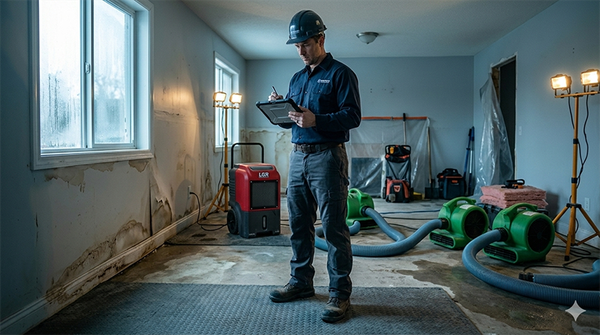
common moisture mapping documentation failures and financial consequences for restoration companies

Frequently Asked Questions About Moisture Mapping

What is a normal moisture reading in a house?

Normal moisture content in residential wood-based materials typically falls between 6% and 14%, depending on climate and season. That range represents equilibrium moisture content: the point at which wood has stabilized to match the ambient humidity of its environment.

The more useful number for restoration purposes is not a universal average but the dry standard established in the specific structure being dried. Unaffected materials in the same building, on the same floor level, in similar wall assemblies, give you the reference reading that actually matters. A wood subfloor reading of 10% in a coastal climate may be perfectly appropriate. The same reading in an arid inland region may be slightly elevated. Chasing a generic target number rather than an established dry standard for the specific structure is one of the subtler documentation errors that creates closeout disputes.

For gypsum drywall, acceptable moisture content is assessed using comparative readings against unaffected reference areas in the same structure rather than a universal fixed threshold, since pin meters on drywall report wood moisture equivalents. For concrete, baseline readings vary significantly by age and mix, which is why unaffected reference readings in the same slab are essential before drying begins.


When should moisture mapping start on a water damage job?

Moisture mapping should start before drying equipment is placed. Not after. Not during setup. Before.

The baseline moisture readings captured at initial assessment are the foundation of every documentation decision that follows. They establish what was wet, how wet it was, and where the boundaries of the loss were on day one. Without them, the entire drying timeline is unanchored.

In practice, the sequence on every water loss should follow this order:

  1. Assess the loss and determine Category and Class
  2. Capture baseline moisture readings across all affected materials and adjacent unaffected reference areas
  3. Document ambient conditions before drying equipment changes the environment
  4. Perform a thermal imaging sweep to identify secondary migration zones beyond the visible wet area
  5. Set up drying equipment and begin daily monitoring documentation

Waiting until equipment is running to start moisture documentation is the single most common field error that creates claim disputes downstream. The adjuster reviewing the file does not see the urgency of that first hour on site. They see a documentation chain that starts with equipment already running and no baseline to measure progress against.


What does dry standard mean under IICRC S500?

Dry standard is the moisture content of unaffected materials in the same structure, under the same ambient conditions, used as the target that drying must achieve before a water damage job can be closed. Under the IICRC S500 Standard for Professional Water Damage Restoration, the dry standard is not a fixed number applied universally across all jobs. It is established at each loss by taking moisture content readings in unaffected reference materials during the initial assessment. Those readings become the benchmark that affected materials must return to before drying is considered complete.

The practical implication is important. A wood framing member in a humid coastal climate will naturally carry more moisture than the same species of framing in a dry inland climate. Applying a single universal target to both losses produces the wrong result in at least one of them. The S500 approach accounts for that by anchoring the target to the actual structure, not a generic chart.

At closeout, documenting dry standard verification means capturing final readings in previously affected materials and comparing them to current readings in the same unaffected reference areas used at baseline. That comparison is the proof of completion. A file that shows equipment removed on a specific date without that comparison has not proven the job is done.


How does moisture mapping affect a water damage insurance claim?

Moisture mapping directly determines how defensible your scope, your equipment quantities, and your drying timeline are when an adjuster reviews the file.

A complete moisture map gives the adjuster a data-backed story from initial assessment through dry standard verification. It shows what was wet and how wet it was at day one, how drying progressed against ambient psychrometric conditions each day, and when materials returned to acceptable moisture content. An adjuster who can follow that story has what they need to approve the scope without calling for clarification or applying arbitrary drying caps.

An incomplete moisture map creates the opposite situation. Missing baseline readings leave the starting condition of the loss undocumented. Gaps in daily psychrometric logs give the adjuster no context for the drying timeline. A closeout file without dry standard verification proves the job ran for a certain number of days, not that it achieved the drying outcome those days were intended to produce.

The downstream cost is real. Adjusters reviewing files without complete moisture documentation typically respond in one of two ways: they reduce the drying timeline to an arbitrary cap, or they flag the file for additional review that delays payment. Neither outcome is a billing dispute in the traditional sense. Both are documentation failures that became margin problems.


What is the difference between a penetrating and non-penetrating moisture meter?

A penetrating moisture meter uses two small pin probes that are pressed or driven into material to measure electrical resistance between them. Because moisture conducts electricity, lower resistance indicates higher moisture content. Pin meters give you a direct moisture content reading at the probe depth, typically expressed as a percentage. They are accurate for specific point measurements and are the standard instrument for S500-compliant moisture content documentation in wood-based materials.

A non-penetrating moisture meter uses electromagnetic signals to scan material moisture content without breaking the surface. It covers ground faster and works without damaging finished surfaces, which makes it useful for initial assessment sweeps across large areas and for scanning finished hardwood flooring where pin holes would cause visible damage.

The key distinction for documentation purposes:

  • Non-penetrating meters are detection tools. They identify where moisture is likely present and where to look more closely.
  • Penetrating meters are documentation instruments. They provide the specific moisture content readings that go into the insurance file.

Using only a pinless meter for moisture documentation is a common field shortcut that creates claim vulnerability. Non-penetrating readings vary with material density, backing materials, and surface conditions, and they do not produce the calibrated moisture content percentages that S500-compliant documentation requires. Every wet zone identified by a pinless sweep needs to be confirmed with pin meter readings before those readings go into the file.


The Bottom Line

Moisture mapping is the documentation discipline that determines whether your water damage files hold up or get challenged. The work happens in the field. The proof lives in the paper trail.

A defensible moisture map requires three things executed consistently on every job:

  • A complete baseline captured before equipment goes in, including readings in affected materials, unaffected reference areas, and any secondary migration zones identified through thermal imaging
  • Daily drying logs that pair moisture content readings with psychrometric data, giving every day of equipment runtime an objective performance record
  • A closeout verification pass that compares final moisture readings in previously affected materials against the dry standard established at baseline

The gaps that cost restoration companies the most are not complicated. Missing baseline readings leave the starting condition undocumented. Surface-only readings on thick substrates miss deeper moisture that causes callbacks. Closeout files that show equipment removed without final readings prove the job ran, not that the job is done.

Carriers are increasingly reviewing submitted documentation through automated systems built to catch exactly these gaps. The documentation that was good enough two years ago is being held to a higher standard today, and that standard is only moving in one direction.

Building moisture mapping into a consistent, team-wide documentation protocol is not a technology problem. It is a workflow clarity problem that shows up as a margin problem every time a file gets challenged.

Build the Protocol, Not Just the Habit

Moisture mapping knowledge is not the problem. Most experienced technicians and project managers understand what a moisture map is supposed to do. The problem is that knowledge does not automatically become consistent field execution across a team, across job types, and across the pressure of a busy week with multiple active losses.

The gaps that cost restoration companies the most -- missing baselines, surface-only readings on thick substrates, closeout files that show equipment removed but not work completed -- are not the result of technicians who do not care. They are the result of teams that do not have a documented protocol that requires the right data at the right phase of every job, regardless of who is on site that day.

That is the difference between moisture mapping as a skill and moisture mapping as a system.

A skill depends on the individual. A system runs regardless of which technician is on the job, which PM is managing the file, or how busy the week is. Building that system requires knowing exactly where your current documentation chain breaks down before you can fix it.

Carriers are not waiting for your team to figure that out on their own. Automated claims review systems are already scanning submitted files for the gaps described in this post. The documentation bar is higher than it was two years ago and it is still rising.

The time to address your moisture mapping protocol is before the next disputed file, not after it.

Ready to find out where your documentation workflow is losing time and margin? The Restoration Growth Blueprint is a structured operational audit for restoration companies that want to understand exactly where their operational systems are breaking down before those breakdowns show up as claim disputes, missed supplements, or delayed payments.

BOOK FREE AI CLARITY CALL

Share this article

Share to Facebook
Share to X
Share to LinkedIn

Written by

Jim West
Jim West
Jim West is a digital operations specialist and MIT-certified AI strategist who helps restoration companies identify where time, margin, and energy are lost in daily operations. He helps teams simplify systems and work with less friction.
https://workwonders.ai/

Join the conversation