Why Restoration Estimating Problems Are Actually Documentation Problems
Better estimating software won't fix a documentation problem. The breakdown happens in the field, before anyone opens Xactimate. Here's where restoration companies lose money they never see and how to stop it at the source.
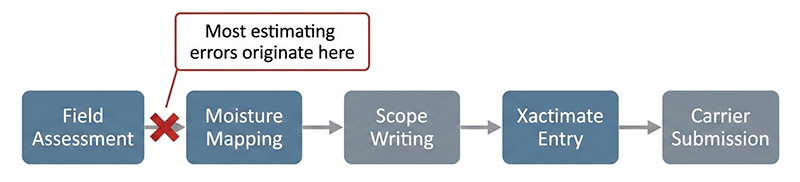
Most restoration estimating problems don't start in Xactimate. They start in the field, when a technician misclassifies the water category, skips a room, or documents moisture readings that don't tell a complete story.
By the time an estimator sits down to write the scope, the damage is already done. Better documentation doesn't just support a better estimate, it is the estimate.
At a Glance
The estimate is only as strong as the field documentation behind it. When the chain breaks down through misclassified categories, incomplete moisture mapping, missed hazard flags, or scope gaps, the estimator is working from incomplete evidence before they ever open Xactimate. Fixing those failures means addressing where they actually happen: in the field, in the first hour of a response, before anyone is thinking about the estimate. AI tools can accelerate and quality-check this process, but only when the documentation workflow feeding them is already structured and complete.
If you've ever lost a supplement battle you should have won, or rewritten a scope because the field notes didn't capture what actually happened on site, you already know this. The estimate looked wrong because the documentation was wrong. And the documentation was wrong because somewhere in the field-to-office chain, critical information didn't make it through.
This is the most common and most expensive workflow problem in restoration. It's also the one that gets misdiagnosed most often. Companies respond by buying better estimating software, training estimators harder, or adding review steps to catch errors before submission. None of that fixes a documentation problem. It just adds friction downstream from where the breakdown actually happened.
The good news is that documentation failures happen at predictable points in the field workflow. They're not random. That means they're preventable, and increasingly, they're catchable in real time before a scope is ever written.
Understanding the workflow clarity process behind your estimating chain is what makes that prevention possible.
This post maps where the documentation chain breaks down, what it costs when it does, and what it looks like when AI is embedded in a clarified documentation workflow, catching errors before they become estimate disputes.
The Estimate Is Only as Good as the Field Documentation Behind It
A restoration estimate is a financial argument. It tells an insurance carrier exactly what happened, what it will take to fix it, and why every line item is justified. The strength of that argument depends entirely on the quality of the information collected before anyone opens Xactimate.
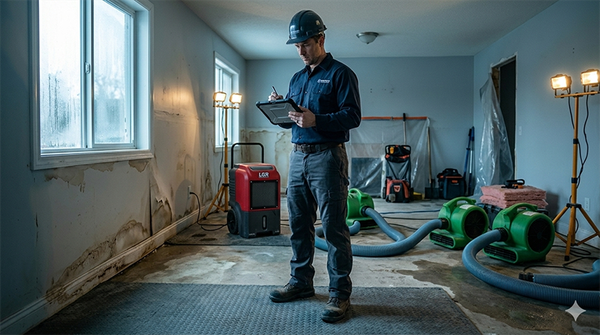
That information comes from the field. And the field is where documentation gets compressed, rushed, and incomplete, not because technicians don't know better, but because they're managing an active loss, communicating with a stressed property owner, coordinating equipment, and trying to move fast. Documentation quality is always competing with everything else happening on site.
The estimate is a financial argument. The field documentation is the evidence. When the evidence is weak, the argument fails, regardless of how well the estimate is written.
Where the Documentation Chain Actually Begins
The documentation chain starts the moment a technician walks through the door on a first response. Before a single line item is written, decisions are being made that shape the entire estimate:
What is the water source?
What category of contamination are we dealing with?
How far has moisture migrated?
What materials are affected, and which ones are salvageable?
These aren't administrative questions. They're technical determinations that drive scope, equipment selection, drying protocol, safety requirements, and ultimately payment.
A Category 1 loss and a Category 3 loss in the same 800 square foot basement produce estimates that can differ by tens of thousands of dollars. The category determination happens in the first fifteen minutes on site. If it's wrong, everything downstream is wrong.
The same is true for moisture mapping. IICRC S500 establishes that moisture readings should be taken and recorded at least daily to document drying progress.
When that documentation is thorough, room dimensions, material types, moisture readings at each measurement point, equipment placement rationale, the estimate writes itself. When it's thin, the estimator is filling in gaps from memory or making assumptions that adjusters will challenge.
This is also why estimating and documentation tops the list of where restoration operators most want AI to help, yet deployment there has barely moved. The AI adoption gap in restoration starts exactly here.