Why Large-Loss Restoration Jobs Go Over Budget Before Day One
Large-loss restoration jobs go over budget before the first crew member arrives. Here is the labor-first estimating methodology that protects margin on commercial losses, from crew sizing to budget range presentation.
With insights from Tom McGuire, founder of Large Loss Mastery and creator of The Edge estimating system, and TJ Wiberley, President and Founder of Patriot Restoration.
Last Updated: May 5, 2026
Large-loss restoration projects go over budget most often because of decisions made before the first crew member sets foot on site. Crew sizing, labor planning, and budget range, set incorrectly in the first estimate, create a margin problem that no amount of field efficiency can fix.
At a Glance
On a large commercial restoration job, the estimate is not the invoice. It is a budget, a rough order of magnitude that sets expectations with the carrier, defines the labor plan, and determines whether the job will be profitable before work begins.
Most restoration companies apply residential estimating habits to commercial losses and get hurt on margins as a result. The methodology that protects margin on large-loss work starts with a labor-first calculation: figure out how many people you need to hit the client's timeline, then build the rest of the budget around that number. When the field data feeding that calculation is accurate and complete, the estimate comes together in minutes. When it is not, the budget is a guess, and guesses on seven-figure jobs are expensive.
When a hotel calls and says they need 100,000 square feet of water-damaged space dried and cleared in 18 days because a convention is coming in, there is no time to open Xactimate and start building line items.
Large-loss projects run under the guidelines and pricing of a Time and Materials contract, scope of work, and project cost estimate. There is a timeline and a critical path that include daily square-footage production expectations and hard deadlines.
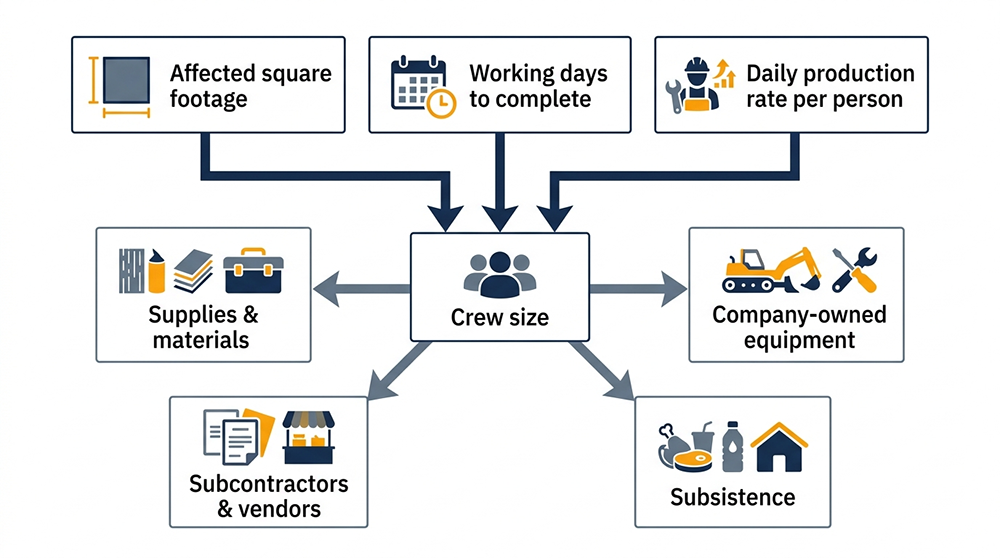
Everything else flows from three key factors: affected square footage, working days to complete the project, and daily labor production rates.
That is the reality of large-loss restoration project management. And it requires a fundamentally different estimating approach than the residential and small commercial work that most restoration companies built their operations around.
The estimating factors themselves are not exclusive to large-loss work. The same methodology applies to any restoration project, residential or commercial.
The main difference between large-loss and smaller projects is the type of client and the level of resources required. What separates the restorers who protect margin from those who do not is knowing which system applies and when to use it.
Most companies do not consider both methodologies when estimating projects. That limits their ability to calculate recovery costs quickly and accurately.
Applying the same line-item thinking to a $1.2M hotel loss that works on a $12,000 water-damaged apartment will not hold margin in a competitive situation. Understanding what they do not know is the biggest challenge for most restorers. By applying those same three factors consistently, restorers can successfully estimate any size project.
The decisions that determine whether a large-loss job is profitable are made within the first 45 minutes of the estimate. Understanding what those decisions are, and what feeds them, is the starting point for protecting margin on commercial work. It is also where workflow clarity becomes a prerequisite, not an afterthought.
The Estimating Mistake Most Restoration Companies Make on Commercial Jobs
Large-loss restoration project management is not a scaled-up version of residential work. It is a different discipline with different tools, different math, and different margin exposure. Most restoration companies do not treat it that way, and the budget pays the price.
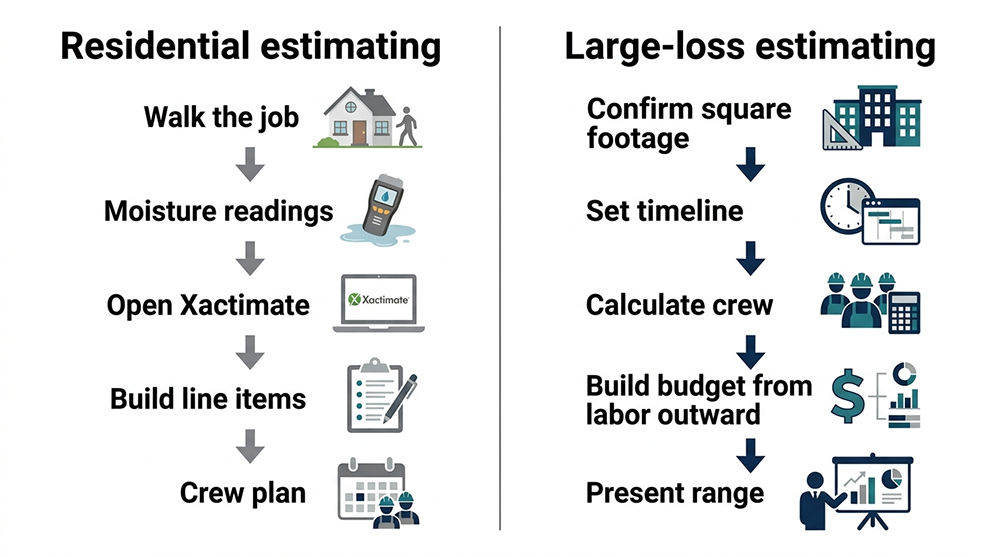
The instinct to open Xactimate and start building line items is deeply ingrained. It works well on a Category 2 water loss in a 1,400 sq ft ranch house. It falls apart on a 12-story hotel with a convention deadline and a carrier consultant watching every decision.
The methodology that protects margin on large commercial losses is not the same one that gets you paid on residential jobs.
The difference is not just scale. It is sequencing. On a large-loss job, you must answer a different first question, and it is not 'what line items apply?' It is 'how many people do I need to hit this timeline?'
Most restorers never factor in the required labor for the project and typically carry too much labor on the job, causing budget overruns and red flags during audits with the adjuster and third-party consultants. Labor size and production are the most common and most scrutinized factors in every project.
An Estimate Is Not an Invoice
This distinction matters more on large commercial losses than anywhere else in restoration estimating. And it applies to every project regardless of size. You cannot submit your estimate and expect payment for the project estimate.
"This is an estimate," Tom McGuire says plainly. "Not your invoice. Your invoice is gonna be billed for what you actually do."
Both Xactimate and Time and Materials projects require back-up documentation for everything performed on the job. The distinction sounds obvious. In practice, it gets blurred constantly.
Restoration often companies present ROM estimates to carriers and clients as if they were commitments, then scramble when actuals diverge. Carriers push back. Consultants flag variances. Payment slows.
A large-loss estimate is a rough order of magnitude: a defensible budget range built from the best information available at the time of assessment. It is a planning tool for the carrier (to set loss reserves), the client, and your own operations team. The invoice comes later, based on what happened on the job.
Treating them as the same document is a tragic mistake that delays payment and jeopardizes future work with insurance companies and third-party consultants.
The golden rule of invoicing: If it isn't documented, it didn't happen.
Why Residential Habits Break Down on Large Losses
On a residential loss, a skilled estimator can walk a job, take moisture readings, sketch the affected areas, and have a defensible Xactimate estimate ready within a few hours. The scope is bounded. The line items are familiar. The variables are manageable.
Add two zeros to the square footage and the math stops working the same way. On a large commercial loss, a hotel, a school, a multi-story office building, the affected area may span tens of thousands of square feet across multiple floors with different building systems, different material types, and different access constraints on every level.
Building a line-item estimate from scratch under those conditions, before mobilization decisions must be made, is the wrong approach for the wrong moment. A labor-first budget must answer the critical operational question first:
How many people, at what production rate, over how many working days, to hit the timeline the client has given you?
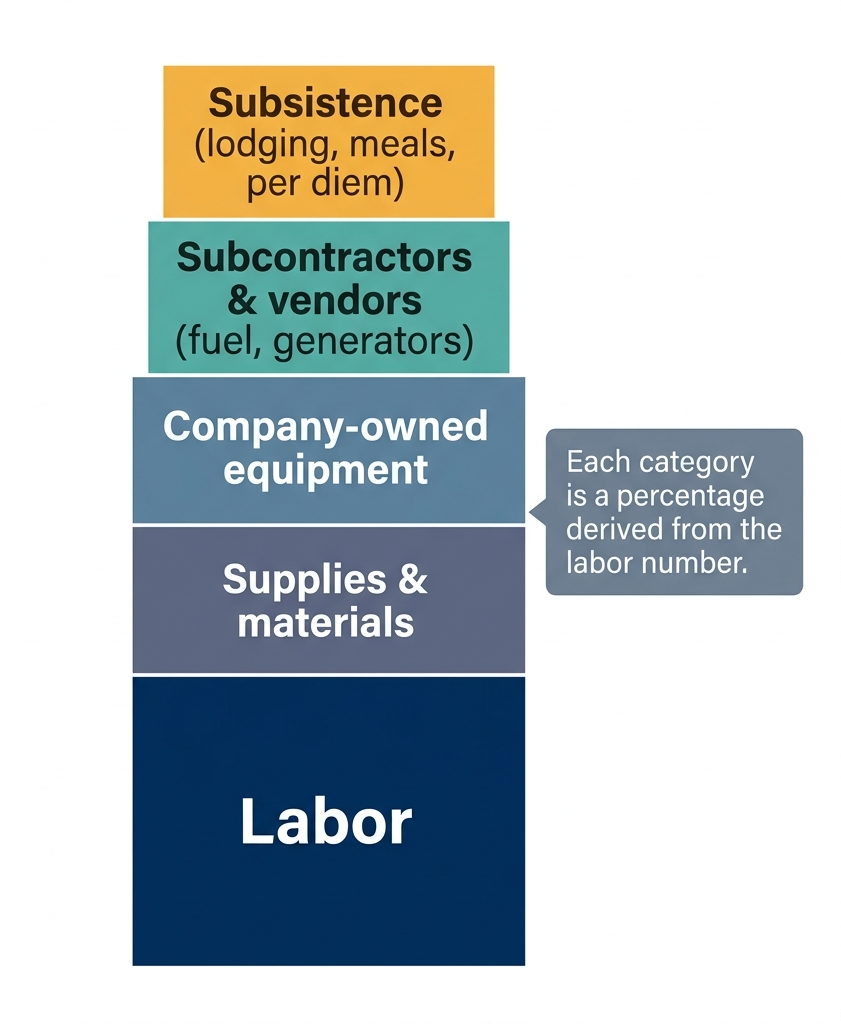
Everything else, type of loss, supplies and materials, equipment, subcontractors, subsistence, flows from that number.
The Number That Determines Your Margin Before Day One
Most restoration companies think about crew size after they have figured out the scope. On large-loss commercial work, that sequence is backwards.
The crew decision is the margin decision. Get it wrong in the estimate and no amount of field efficiency will recover the job. You will either be over budget because you staffed too heavy, or you will miss the client's deadline because you staffed too light. Both outcomes are expensive. Both are avoidable.
Tom McGuire puts it plainly: "Too many people on the job means your margins are gonna be lower. And your budget is gonna be over budget, and you're gonna be on the radar with the carrier, with the consultant, everybody involved with the project. Our job is to keep you off of that radar and to get you paid quickly."
That framing matters. Being on the carrier's radar is not a neutral position. It invites scrutiny, slows payment, and puts your relationship with the adjuster and any third-party consultant under pressure for the duration of the job.
Start With People, Not Line Items
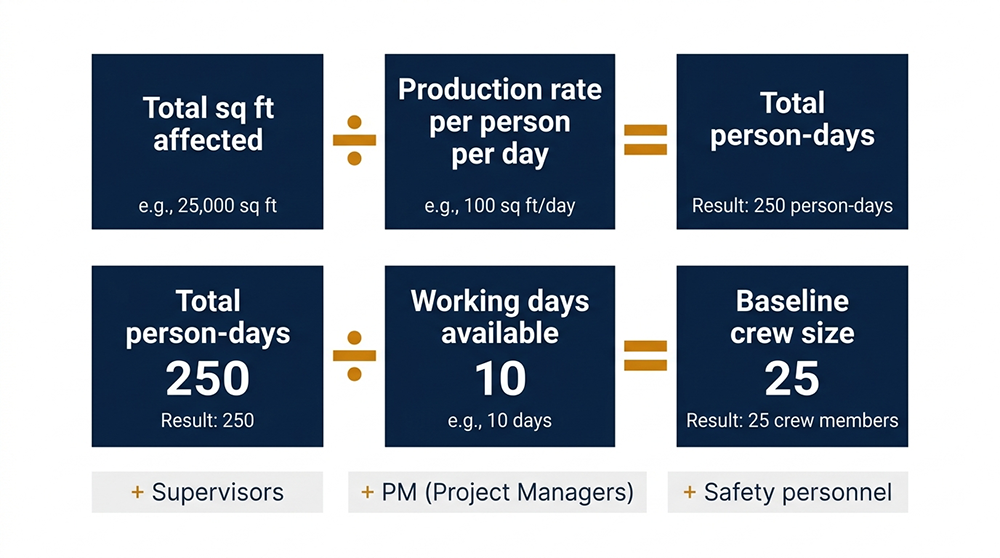
The math behind crew sizing on a large-loss job is straightforward once you know the inputs. The calculation works in three steps:
Total person-days needed: Divide total affected square footage by your production rate per person per day for the loss type involved.
Baseline crew size: Divide total person-days by the number of working days the client has given you.
Adjusted crew: Layer in supervisors based on building complexity, a project manager, safety personnel if required, and any specialists the loss type demands.
On a 100,000 square foot hotel loss with an 18-day window and an established production rate per person per day, that calculation yields a credible starting crew size in minutes, before a single line item is written.
This is the inverse of how most restoration companies approach commercial estimating. They build the Xactimate first and back into a crew plan later, often under mobilization pressure and without enough time to think clearly about what the job requires. The crew decision ends up being a gut call rather than a calculated one, and gut calls on seven-figure jobs carry real risk.
The Cost of Overstaffing (and Understaffing)
Both directions hurt, and they hurt differently.
Overstaffing inflates your labor number, pushes your budget over what the carrier expected, and signals poor planning to everyone reviewing the estimate. Carriers and consultants track labor density.
A job staffed well beyond a defensible production rate raises questions that slow approval and payment.
Understaffing is quieter but often more damaging. If the crew cannot hit the client's timeline, you are managing a relationship problem on top of an operational one. For a hotel with a convention booked, missing the 18-day window is not a rounding error. It is a business disruption for the property owner and a credibility problem for you.
Tom McGuire describes TJ Wiberley's approach at Patriot Restoration this way: "Restorers who 'get it,' like TJ, are great examples of those who use Xactimate only when specifically needed or required by an adjuster or TPA to placate their needs, and utilize the T&M system on every project, regardless of the type of project."
That disciplined approach to methodology selection, knowing which system fits the job rather than defaulting to the familiar one, is what separates operators who protect margin from those who wonder where it went.
The production rate calculation does not eliminate judgment. Building configuration, floor count, loss type, and access constraints all require the estimator to adjust the baseline. But it gives you a defensible starting point rather than a number pulled from experience alone. That defensibility matters when a carrier consultant reviews your labor line.
How the Budget Builds From Labor Outward
Once the crew size is established, the rest of the large-loss budget follows a logical structure. Each major cost category derives from the labor number as a percentage, adjusted by the estimator's experience with the specific job type, building configuration, and geographic factors like travel and lodging.
This is the methodology that allows a seasoned large-loss estimator to produce a credible budget range in 15 to 45 minutes. Not because the work is simple, but because the framework is clear and the inputs are defined.
When the labor number is right, the rest of the budget has a foundation. When it is not, every percentage built on top of it is wrong in the same direction.
Why Presenting a Range Protects You
One of the most professionally significant moves a restoration company can make on a large commercial loss is presenting a budget range rather than a single number.
A high and a low. On a well-scoped large hotel loss, that might look like $1.1M on the low end and $1.3M on the high. Both numbers are well-supported. Both are built from the same labor-first calculation with percentage-based categories layered on top.
The range communicates to the carrier and the client that you understand the job well enough to bracket it accurately, without overcommitting to a specific figure when conditions on site may still be evolving.
Carriers and their consultants have seen enough large-loss estimates to know the difference between a contractor who guessed at a number and one who calculated it. A documented range with clear methodology signals operational competence.
It also gives you room to manage actuals without triggering a dispute every time field conditions shift from the initial assessment.
The Categories Most Companies Underestimate
The percentage-based categories that sit above the labor line are where large-loss budgets quietly fall apart. In the experience of professionals who run these jobs regularly, a few categories stand out as the most consistently misjudged:
Subsistence. When a crew mobilizes to a job site two states away, lodging, meals, and per diem costs add up fast. Hotels near active loss events are expensive. A subsistence percentage calibrated for local work does not survive a regional or national mobilization.
Fuel. Fuel is often the highest single subcontractor line on a large-loss job. Generator fuel consumption over 18 days at a 100,000 square foot site adds up to a number that deserves its own calculation, not a quick estimate.
Power distribution. A large commercial building rarely has enough existing power infrastructure to run full mitigation equipment across multiple floors simultaneously. Generator rental on a large hotel job represents a substantial line item that an estimator without large-loss experience may miss entirely.
The discipline of the percentage-based approach forces the estimator to account for each category explicitly rather than letting them blur together in a Xactimate total. It also makes the budget auditable. When a carrier asks why the subcontractor line is where it is, you have documented rationale rather than a number that came from intuition.
Where AI Fits Into Large-Loss Estimating
The labor-first methodology is mature. Restoration professionals have been using production rate calculations to staff large commercial losses for decades. The framework is not new.
What has changed is the quality and speed of the field data feeding into it.
Tom McGuire captures the dependency plainly:
"Once we have our damage assessment done, we have good information. All of it plays in and goes very, very quickly."
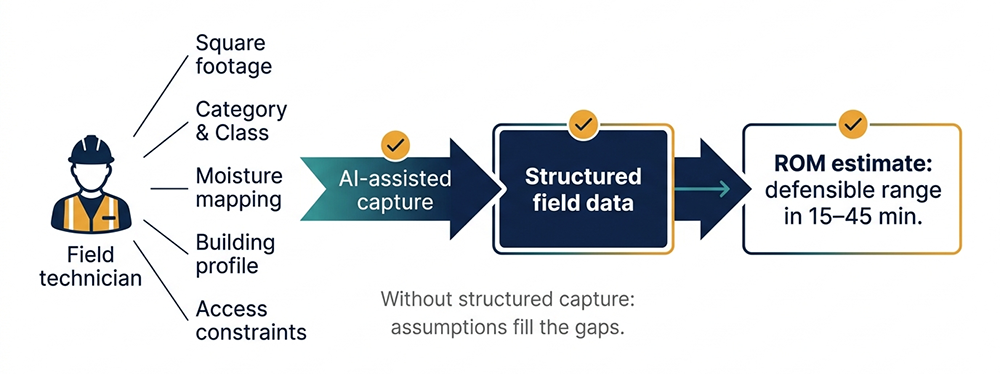
That last sentence is the key. The estimate builds fast when the inputs are clean. Square footage is confirmed. Affected areas are documented. Category and Class determinations are made and recorded. The timeline is set. When those inputs arrive complete and structured, the crew calculation takes minutes and the budget follows. When they do not, the estimator fills gaps with assumptions, and assumptions on a seven-figure job carry real cost.
The bottleneck on large-loss estimating is not the methodology. It is the quality of the field data flowing into it.
The Real Bottleneck Is Not the Estimate, It Is the Data
Consider what the estimator must have before a defensible ROM can be built:
Confirmed square footage by affected zone
Category and Class determination for each area (a Category 3 loss in 30,000 sq ft of a hotel basement is a fundamentally different budget than Category 1 across the same footprint)
Moisture mapping across affected materials
Building profile details, including year of construction (pre-1980 structures trigger asbestos testing requirements that add days to the timeline and costs to the estimate)
Floor count and access constraints that affect crew deployment
Equipment infrastructure, including whether existing building power can support full mitigation load or whether generator distribution is required
In most restoration companies, that information travels from the field to the estimator through phone calls, photos in a group text, notes on a clipboard, and memory. It degrades at every handoff. This is the core argument explored in depth in why restoration estimating problems are really documentation problems.
The field-to-estimate gap is not unique to large-loss work, but the financial consequences are larger by an order of magnitude when the job is seven figures.
Industry analysis of over 40,000 Xactimate estimates confirms the connection: tools that improve initial field documentation reduce omissions, standardize methodology, and shrink approval timelines. Poor initial walkthroughs miss critical details that accumulate to degrade estimate quality and defensibility over time.
What Structured Field Documentation Makes Possible
When field documentation is complete, structured, and delivered to the estimator in a usable format, the budget calculation becomes close to mechanical.
The square footage is confirmed, not estimated. The Category and Class are documented, not assumed. The affected zones are mapped, not described verbally. The building profile is recorded, not recalled from memory. The estimator runs the crew calculation, applies the percentage-based categories, and presents a defensible range within the window that large commercial losses demand.
This is where AI-assisted field documentation connects directly to margin protection on large-loss work. Voice-to-scope tools, structured intake workflows, and AI-assisted assessment capture are not replacing the estimating methodology. They feed it with better inputs, faster. The goal is not automation of the estimate. It is accuracy of the data that makes the estimate possible.
As AI workflow automation in restoration operations makes clear, the companies getting the most value from AI-assisted tools are not the ones who adopted fastest. They are the ones who clarified their workflows first, then applied automation to a process that was already well-defined. Large-loss field documentation is exactly that kind of process.
Ready to find out where your large-loss workflows are losing time and margin? The Restoration Growth Blueprint is a structured operational audit for restoration companies that want to understand where friction lives before deciding what to fix.
Frequently Asked Questions About Large-Loss Restoration Estimating
What is a ROM estimate in restoration?
A ROM estimate, or rough order of magnitude estimate, is a high-level budget range produced at the start of a large commercial restoration project. It is not a line-item invoice. It is a planning document built from labor calculations, historical production data, and percentage-based cost categories that gives the carrier, the client, and the restoration company a defensible cost range before mobilization begins.
On a well-scoped large-loss job, a ROM is produced in 15 to 45 minutes when field data is complete. The range, typically presented as a high and low figure, sets expectations for all parties and reduces the likelihood of disputes when actuals are invoiced against what was actually performed.
How do you calculate crew size for a large-loss restoration job?
Crew sizing on a large commercial loss starts with three inputs: total affected square footage, the client's required completion timeline in working days, and your established production rate per person per day for the loss type involved.
Dividing square footage by production rate gives you total person-days required. Dividing that by available working days gives you the baseline crew number. From there, the estimator adjusts for:
Building complexity and floor count
Category and Class of loss
Access constraints
Specialized roles such as supervisors per floor, safety personnel, or document recovery specialists
The calculation gives you a defensible starting point rather than a number based on intuition, which matters when a carrier consultant reviews your labor line.
Why do large-loss restoration jobs go over budget?
Most large-loss budget overruns trace back to one of three causes:
Crew sizing not calculated from production rates. This leaves the labor number too high or too low from the start, and every percentage-based category built on top of it is wrong in the same direction.
Underestimated cost categories. Subsistence, fuel, and power distribution on jobs requiring mobilization and generator infrastructure are consistently misjudged when guessed at rather than calculated.
Incomplete field data. Missing or inaccurate information at the time of the initial estimate forces the estimator to make assumptions that actuals later contradict.
All three are planning problems. They originate in the estimate, not on the job site.
How does AI help with large-loss restoration estimating?
AI does not replace the estimating methodology on large-loss work. The labor-first calculation, the percentage-based budget categories, and the range presentation are all human judgment calls built on decades of production data.
What AI-assisted tools improve is the quality and speed of the field data flowing into that methodology. Voice-to-scope documentation, structured field capture, and AI-assisted assessment tools help field teams record the following in a complete and structured format that arrives to the estimator ready to use:
Category and Class determinations
Moisture mapping data
Building profile details
Affected zone documentation
When the inputs are clean, the estimate builds fast and the budget is defensible. That is where AI creates direct margin value on large commercial losses.
The Bottom Line
Large-loss restoration project management is won or lost in the estimate, not on the job site. The crew sizing calculation, the percentage-based budget categories, and the range presented to the carrier all happen before mobilization. Get those right and the job has a foundation. Get them wrong and no amount of field efficiency closes the gap.
The methodology is not complicated. Three inputs determine the crew:
Square footage of the affected area
The client's required timeline in working days
Your established production rate per person per day
The crew determines the labor number. The labor number anchors every other cost category. The result is a defensible range that sets accurate expectations with the carrier, keeps you off the consultant's radar, and protects the margin that makes the job worth taking.
What makes the methodology work consistently is the quality of the field data feeding it. Complete moisture mapping, confirmed Category and Class determinations, accurate building profiles, and documented access constraints do not just support the estimate. They are the estimate. When that information arrives structured and complete, the budget comes together fast. When it does not, the guesswork starts, and guesswork on commercial losses is expensive in ways that show up long after the job closes.
The Work That Protects Margin Happens Before Day One
Large-loss restoration project management rewards preparation in a way that most other work in this industry does not. The field is unpredictable. The buildings are complex. The timelines are tight. But the framework that determines whether a job is profitable is knowable before mobilization begins, and it starts with a calculation most restoration companies skip.
Figure out how many people you need to hit the timeline. Build the budget from that number outward. Present a defensible range. Make sure the field data feeding all of it is complete and structured before the estimate is built.
That is the discipline that keeps a large commercial loss off the carrier's radar, protects the margin that makes the job worth taking, and positions your company as the kind of operation that can handle this work again.
Tom McGuire has spent more than three decades developing and teaching this methodology through Large Loss Mastery. TJ Wiberley and the team at Patriot Restoration apply it in the field on commercial and government losses across East Tennessee. The principles in this post reflect their combined experience with large-loss work at the operational and training levels.
If your company is moving into larger commercial losses, or already taking them and feeling the margin pressure, the place to start is not a new estimating tool. It is a clear picture of where your current workflow is losing time and money before the crew ever arrives on site.
Want to know exactly where your restoration operation is leaking margin? The Restoration Growth Blueprint is a structured operational audit that identifies the friction points in your workflows before you invest in fixing them. Built specifically for restoration companies ready to run tighter operations on larger jobs.
Jim West is a digital operations specialist and MIT-certified AI strategist who helps restoration companies identify where time, margin, and energy are lost in daily operations. He helps teams simplify systems and work with less friction.
Owner - Patriot Restoration. Instructor - LargeLossMastery.com. Master of THE EDGE estimating system and managing labor production rates to maintain healthy profit margins and happy clients.
Founder, Owner, The Solutions Company, LLC - Loss & Large Loss Mastery Trainer, Teacher, Learner, Mentor, Historian. 40-year veteran of Large Loss and Disaster Recovery.