The AI-Ready Restorer Manifesto: A Practical Path to Smarter Restoration Operations
AI-ready restoration operations start with workflow clarity, not tools. This manifesto explains why most AI implementations fail, how work really breaks down inside restoration businesses, and what practical changes are actually improving margins and reducing operational friction.
AI-ready restoration operations start with workflow clarity, not tools. This manifesto explains why most AI implementations fail, how work really breaks down inside restoration businesses, and what practical changes are actually improving margins and reducing operational friction.
At a Glance
Most restoration companies don't have a technology problem. They have a visibility problem. Being AI-ready means understanding how work flows through your business before applying automation, not buying more tools. Workflows break down at predictable points: intake handoffs, field-to-office transitions, and documentation gaps that quietly erode margins. The companies getting real results from AI started with one role, one workflow, and one measurable improvement, then built from there.
Over the last few years, restoration businesses have been asked to do more with less. More documentation, more communication, more systems, more compliance, and more speed — all while margins tighten and teams feel the strain.
In the middle of that pressure, a new promise keeps appearing: AI.
For many leaders, it feels vague at best and overwhelming at worst.
This blog exists to change that.
What Being AI-Ready Actually Means in Restoration
Being AI-ready in restoration operations means understanding how work flows through your business before applying automation.
It focuses on identifying where time and margin are being lost, clarifying workflows, and embedding AI into specific friction points rather than adding more tools on top of existing chaos.
If you want to know more about who's behind this publication and why it exists, the About page covers that.
The Restoration Industry Doesn’t Have a Work Ethic Problem. It Has a Workflow Problem.
The restoration industry has never been short on hard work. What it's short on right now is clarity.
Most operational stress doesn't come from lack of effort. It comes from fragmented workflows, disconnected systems, and coordination overload.
Reports assembled from multiple disconnected tools
That is not a people problem. That is a workflow design problem.
This blog focuses on how restoration work actually flows and where that flow breaks down.
The Problem With How AI is Being Adopted in Restoration
Right now, many restoration companies are approaching AI the wrong way. They are starting with tools instead of workflows.
They are asking:
What AI platform should we use?
How do we train our team on ChatGPT?
What software integrates with what?
But they are not asking:
Where does work actually break down?
Where are we losing time every day?
Where is margin quietly eroding?
What tasks shouldn't exist in the first place?
When AI is layered on top of broken workflows, it adds complexity instead of removing it. More dashboards, more prompts, more training, more confusion. That is not transformation. That is digital clutter.
AI only works when it is embedded into a clarified workflow — not bolted onto chaos.
The difference between tool-first and workflow-first adoption looks like this:
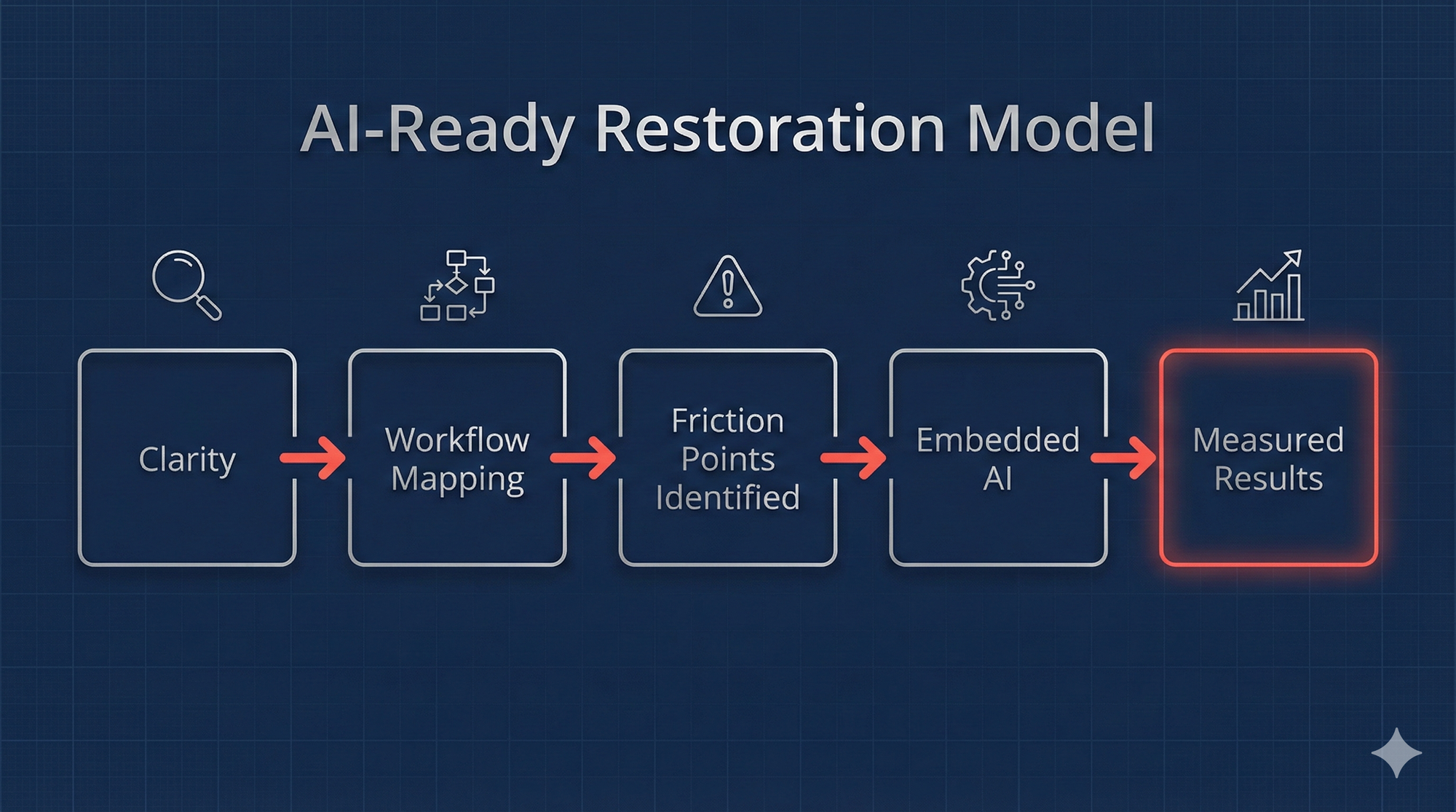
The AI-Ready Restoration Model: Clarity before Automation.
Why do AI implementations fail in restoration companies?
AI implementations fail in restoration companies because they are introduced without workflow clarity. When automation is layered onto fragmented processes, it increases complexity instead of reducing friction.
In many cases, leaders adopt AI tools before identifying where coordination breaks down, where duplicate work exists, or where communication stalls. Without that visibility, automation amplifies inefficiencies instead of removing them. The result is more dashboards, more training, and more frustration, not measurable margin impact.
That's why many AI initiatives feel busy but fail to produce measurable margin improvement.
What “AI-Ready” Actually Means
Being AI-ready does not mean:
Using the latest tools
Training your entire team to become AI experts
Replacing people
Reinventing your business overnight
Being AI-ready means something much simpler... and much harder. It means understanding how work actually flows through your operation. Where time is being lost. Where coordination breaks down. Where good people are spending energy on tasks that shouldn't exist anymore.
The hard part isn't technical. It's behavioral. Most restoration owners are so deep in the daily work - managing active jobs, handling escalations, keeping crews moving - that stepping back to examine how the business actually operates feels like a luxury they can't afford.
But that examination is exactly what separates companies that get real results from AI from those that just add more tools to an already complicated stack. You can't map what you've never looked at. You can't fix what you haven't stopped long enough to see.
Most restoration companies don't struggle because their teams aren't working hard enough. They struggle because the work itself has become fragmented, manual, and unnecessarily complex. Technology didn't create that problem. But technology, used poorly, has made it worse.
When workflow clarity is missing, the cost is not just frustration. It shows up in measurable ways.
The Real Cost No One Budgets For
When owners talk about rising costs, the conversation usually centers on labor rates, materials, pricing pressure, and insurance reimbursement. What often gets missed is the cost of coordination.
The emails, the follow-ups, the handoffs between systems, the duplicate data entry, the status updates, the insurance back-and-forth; none of that shows up cleanly on an estimate. It's operational friction that consumes time, energy, and margin without ever getting a line item.
This is why many software investments fail to deliver real ROI. They add features but don't remove work.
Not Sure Where AI Fits in Your Operations? If you’re unsure whether your workflows are ready for structured AI adoption, start with clarity, not tools.
One of the most common mistakes I see is companies trying to "go big" with AI. Big platforms, big rollouts, big expectations. That approach almost always creates friction.
Teams are asked to learn new systems on top of already full workloads. Leaders expect transformation before there's buy-in. Complexity increases instead of decreasing.
The fastest progress does not come from big moves. It comes from small, focused changes that remove pain immediately. When a single role gets hours back in their day, stress drops, quality improves, capacity increases, and trust builds. That trust is what makes larger change possible.
A Real Example of What “Small and Focused” Looks Like
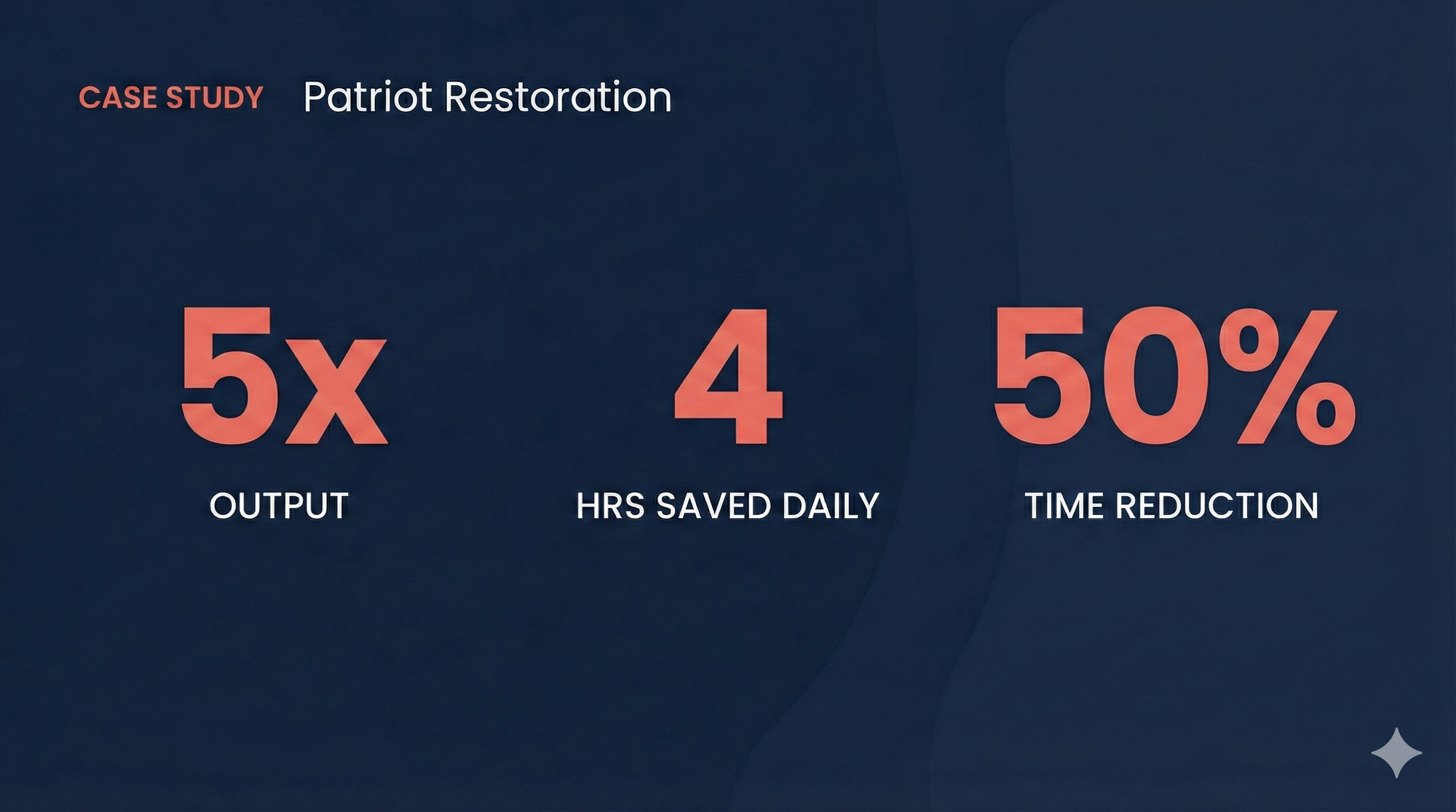
At Patriot Restoration, a single focused implementation changed one role overnight. No massive rollout. No team retraining. Just one workflow clarified and rebuilt.
"If I had to go back to doing my job without AI, I think I'd quit. It's probably saving me about 4 hours per day. I can produce five times the amount of what I was with this tool. It's also allowed me to produce a much better quality report."
— Claims Specialist, Patriot Restoration
This is what happens when AI is embedded into a clarified workflow instead of layered onto chaos. One role changes. Then momentum builds.
How Work is Actually Changing
The future of work in restoration is not endless prompting in chat windows. It is delegation; not to another person, but to systems that handle repetitive work quietly in the background, with humans still in control.
The estimator reviews instead of rebuilding from scratch. The project manager validates instead of chasing updates. The admin team oversees instead of manually coordinating everything. The human stays in the loop. The system carries the load. That is where meaningful ROI lives.
Why Clarity Comes Before Automation
You cannot automate what you do not understand.
If you don't know where time is being lost, you will automate the wrong things. If you don't know which workflows are breaking your team, you will solve the wrong problems. If you don't understand how work really moves through your business, technology will add noise instead of relief.
That is why the first step is never tools. The first step is clarity.
This is the thinking behind the Restoration Growth Blueprint. It exists to give restoration leaders a structured view of:
Where time and margin are leaking
Which workflows create the most friction
What should be fixed first
What should be left alone
Only then does AI make sense.
What This Blog is Here to Do
This publication is built on one idea: clarity comes before automation. AI for restoration companies only works when the workflow is visible first. The companies that win the next phase of this industry won't be the ones with the most technology. They'll be the ones who simplified first.
For the full editorial philosophy behind what gets published here and why, read this.
Not Sure Where AI Fits in Your Operations? If you’re unsure whether your workflows are ready for structured AI adoption, start with clarity, not tools.
Frequently Asked Questions About AI in Restoration Operations
What does it mean for a restoration company to be AI-ready?
Being AI-ready means understanding how work flows through your operation before applying automation. It means identifying where time is lost, where handoffs break down, and where margin quietly erodes.
An AI-ready company can clearly explain how a job moves from intake to scope, estimating, documentation consistent with IICRC standards, insurance communication, and closeout. They know where information is re-entered and where follow-ups stack up.
Once that is visible, AI becomes practical. It supports specific friction points like turning notes into structured documentation, standardizing reports, or reducing repetitive coordination.
AI-readiness is not about becoming more technical. It is about building enough operational clarity that technology removes work instead of adding more.
Why Does Tool-First AI Adoption Fail in Restoration?
Most AI implementations fail because companies start with tools instead of workflow clarity. Without identifying where time and margin are being lost, automation adds complexity instead of removing it.
When teams are already stretched, new systems create new steps. Extra logins, extra training, more places for information to live.
If the underlying workflow is fragmented, AI simply accelerates the fragmentation. That is why early AI efforts often feel busy but produce little measurable improvement.
The solution is simple. Start with one role and one high-friction workflow. Map it. Remove unnecessary steps. Then embed AI where it eliminates repetitive work.
When someone gains real hours back in their day, adoption becomes easier and momentum builds.
Should restoration companies start with a full AI rollout?
No. Large AI rollouts usually increase friction and overwhelm teams. The most successful implementations begin with small, focused improvements that remove pain immediately.
A full rollout requires training, process changes, and tool changes all at once. That is difficult in a business where schedules are tight and interruptions are constant.
Instead, start with a workflow that already consumes too much time — scope documentation, report assembly, job updates, insurance communication. Implement one solution that fits the existing process and requires little to no learning curve.
Measure the time saved and quality improvement. When the team feels relief, trust builds. In restoration, steady operational wins outperform big transformations.
How can AI improve restoration estimating and documentation?
AI improves estimating and documentation by reducing repetitive assembly while keeping experienced professionals in control of final review.
AI can compare documentation against templates, flag missing elements, and reduce back-and-forth caused by incomplete reporting.
The goal is not to train estimators to become AI experts. The goal is to embed AI into the way they already work.
When the system handles repetitive formatting and organization, professionals focus on judgment and accuracy. Reporting gets faster. Quality improves. Capacity increases without adding headcount.
The Restoration Industry Association has long emphasized that documentation quality is a core professional competency, and AI makes it easier to maintain that standard consistently.
What is the first step before implementing AI in a restoration business?
The first step is operational clarity. A structured workflow audit identifies where time and margin are leaking before automation is introduced.
You need to see where work slows down and why. Map the main workflows. Identify the most expensive friction points.
Separate repetitive tasks from those that require experience and judgment. Then choose one starting point — one role, one workflow, one measurable outcome.
This prevents wasted effort and avoids automating the wrong thing. When the workflow is clear, AI becomes a practical tool for removing busywork, improving consistency, and increasing capacity. Without clarity, technology only adds noise.
The Bottom Line
Being AI-ready is not about the tools you buy. It's about whether you can see how work moves through your business clearly enough to know where automation actually helps. Start with one role. Map one workflow. Fix one friction point. Measure what changes. That sequence, clarity before automation, is what separates companies that get real results from those that just add more software to an already complicated operation.
Not Sure Where AI Fits in Your Operations? If you’re unsure whether your workflows are ready for structured AI adoption, start with clarity, not tools.
Jim West is a digital operations specialist and MIT-certified AI strategist who helps restoration companies identify where time, margin, and energy are lost in daily operations. He helps teams simplify systems and work with less friction.